
Subtotal:
CHF0.00
Phone Charging Lockers Switzerland | Hire, Rent & Buy
Secure, branded phone charging lockers for events, conferences and exhibitions across Bern, Zurich and Geneva. Hire, rent or buy with Swiss-wide delivery.
Introduction: Why Phone Charging Has Become Essential Event Infrastructure in Switzerland
Walk into any major conference in Zurich, a banking summit in Geneva, or a corporate exhibition in Bern today, and you’ll notice something that would have seemed unremarkable a decade ago but is now considered core infrastructure: a phone charging station. Somewhere between the registration desk and the coffee point, delegates cluster around a locker or kiosk, plugging in devices that have become as essential to attending an event as a name badge.
This shift is particularly pronounced in Switzerland’s financial and banking sector. Conferences such as those held during Swiss banking weeks, wealth management summits, fintech expos, and international finance forums bring together delegates who are, by the nature of their profession, permanently connected — checking markets, responding to clients, coordinating across time zones. A dead phone at a networking event is not a minor inconvenience for a relationship manager or a fund director; it can mean a missed call from a client, a lapsed deal update, or simply the inability to exchange contact details via a QR code at the exact moment it matters.
This guide is written for event organisers, conference producers, exhibition managers, hotels, and venues across Bern, Zurich and Geneva — with particular attention to the requirements of financial services events — who need to understand what phone charging lockers and stations actually are, how they work, what security and technical standards to expect, and whether hiring, renting or buying is the right decision for a specific event or venue.
Vischarge (vischarge.ch) supplies, installs and services phone charging lockers, lockable charging stations, and non-locker charging kiosks across Switzerland, with particular experience supporting financial sector conferences, exhibitions, and corporate events in Bern, Zurich and Geneva. Everything below is written to be genuinely useful whether or not you ever get in touch with us — but if you’re currently planning an event and need charging infrastructure, our team can talk through requirements at any stage.
Part One: Understanding Phone Charging Lockers and Stations
What Is a Phone Charging Locker?
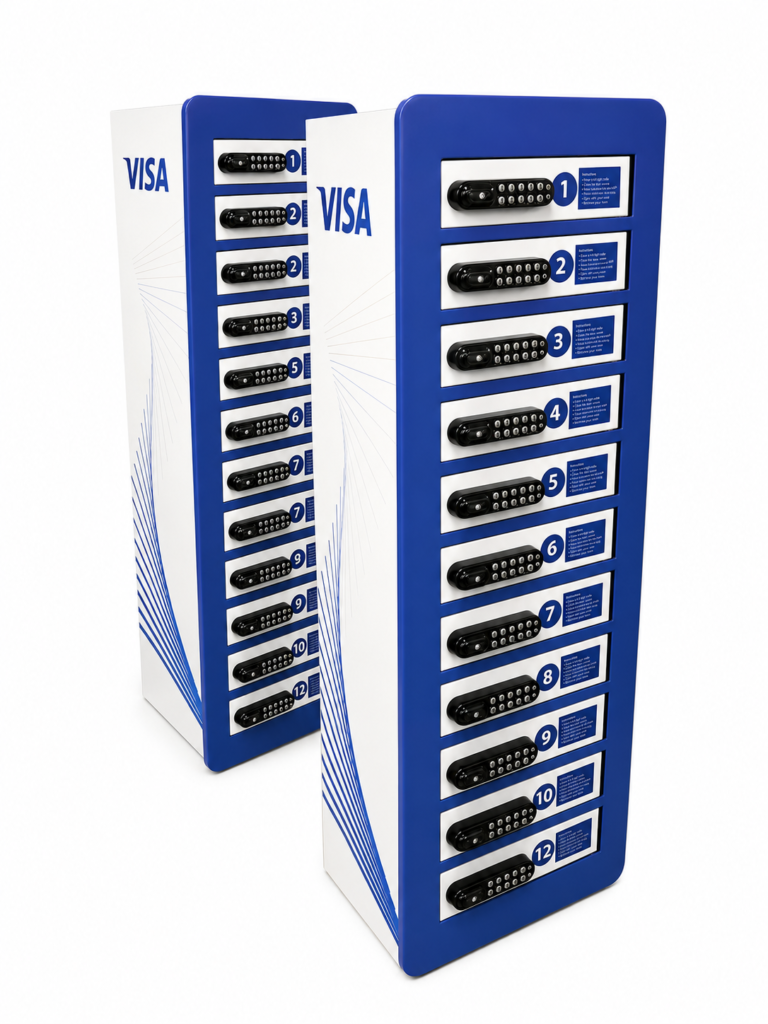
A phone charging locker is a secure, self-contained unit made up of individual compartments, each with its own charging cable and lock. A guest places their phone in a compartment, connects it to the built-in cable (typically USB-C, Lightning, or a Qi wireless pad), closes the door, and locks it — usually via a digital keypad code, an RFID token, or occasionally a physical key. The phone charges unattended and securely inside the locker until the guest returns to retrieve it.
This differs meaningfully from an open charging shelf or a charging table, because the locking mechanism means guests can walk away — into a keynote session, onto an exhibition floor, into a networking lunch — without needing to stand guard over their device or leave it in the care of a stranger.
For financial services events in particular, where delegates are often carrying phones with two-factor authentication apps, trading platforms, and client communications, the ability to lock a device away rather than leave it on an open shelf is not a luxury feature — it’s frequently a compliance-adjacent expectation from delegates’ own employers.
How a Phone Charging Locker Physically Works
Most modern units follow a broadly similar sequence:
- The guest selects an empty, unlit or green-indicated compartment.
- They connect their device to the in-locker cable (many lockers now offer a choice of USB-C, Lightning and Micro-USB within the same compartment, plus a wireless charging pad in premium units).
- They close the door and set a PIN code on the keypad, or the system issues an RFID wristband or token linked to that compartment.
- The locker charges the device using regulated, fast-charging circuitry, typically capped for safety at a set wattage per port.
- The guest returns, enters their PIN or taps their token, and retrieves the device.
What Is a Phone Charging Station?
A phone charging station is the broader category: any dedicated unit designed to charge multiple devices at once. This includes lockable units (see above) but also non-locker charging stations — open stands, charging towers, and charging tables where cables are simply available for guests to plug into and charge while remaining nearby, without a locking compartment.
Non-locker stations are common in:
- Coworking spaces and offices, where the environment is already controlled and trusted
- Hotel lobbies, where guests typically charge briefly while waiting
- Casual networking areas at conferences, where the charging point doubles as a natural gathering spot
- Retail environments, where footfall dwell-time is the goal rather than long unattended charging
Phone Charging Kiosks
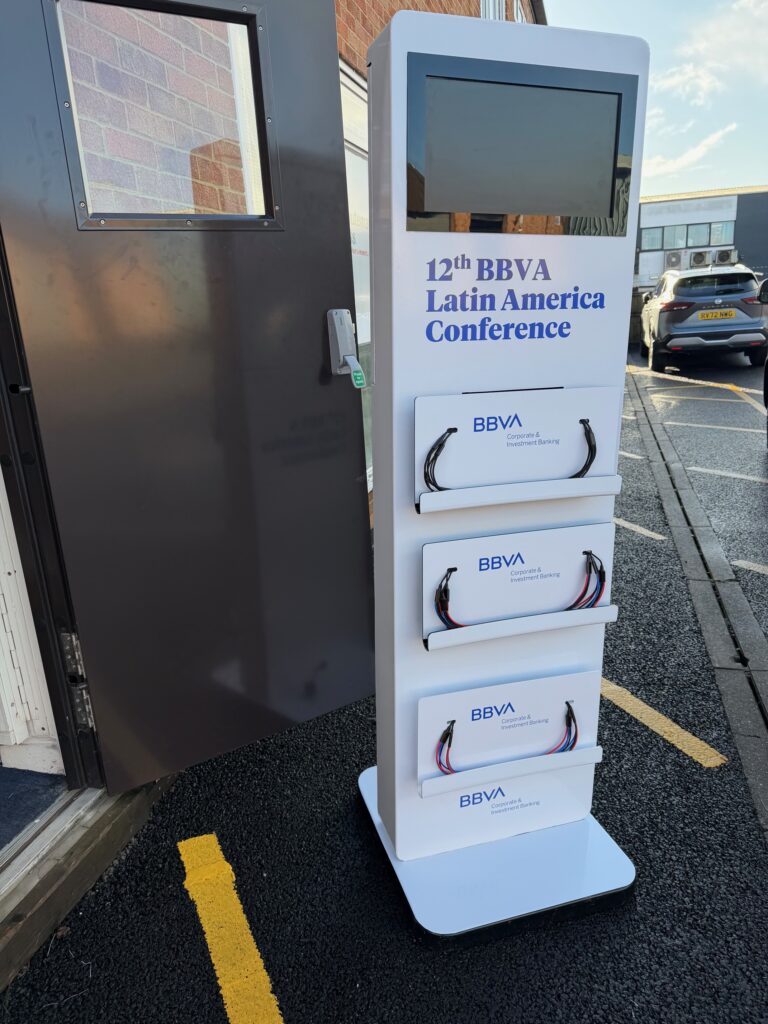
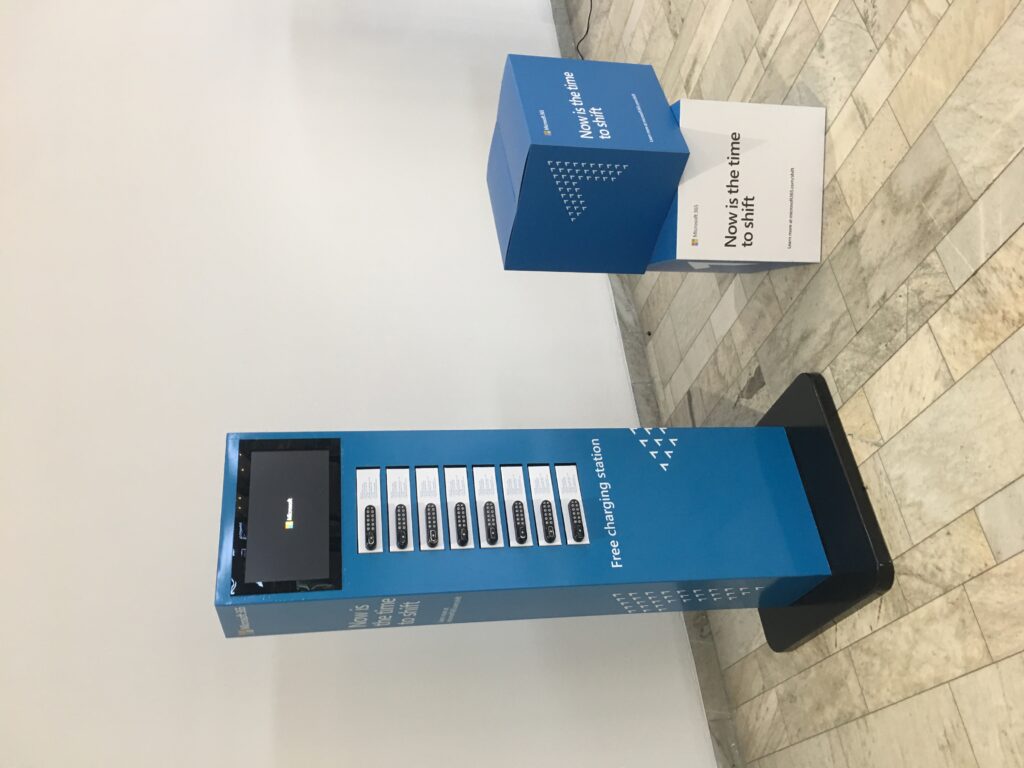
“Kiosk” is often used interchangeably with “station” in Switzerland’s events market, but it typically refers to a larger, more furniture-like unit — sometimes with an integrated LCD display for branding, sponsor messaging, or wayfinding content, and often designed to function as a standalone piece of exhibition architecture rather than a purely functional charging point. A branded charging kiosk at a Zurich fintech exhibition, for example, can double as a sponsor activation and a lead-generation point, not just a battery top-up.
Phone Charging Tables
Charging tables integrate power delivery into ordinary-looking furniture — a café-style table or bar-height standing table with concealed cables running to a central socket or embedded wireless pads. These are popular at hotel conference centres and exhibition catering areas in Geneva and Zurich, where organisers want charging to feel incidental rather than like dedicated technical infrastructure.

How Secure Are Charging Lockers?
Security is usually the first serious question a conference producer or head of events asks, and it’s worth answering properly rather than with a one-line reassurance.
Physical Security
- Individually locked compartments mean no other guest — and no member of event staff — can open a locker without the original PIN or RFID token.
- Steel or reinforced composite housings on most professional-grade units resist forced entry far better than a simple cabinet.
- Anchored or weighted bases prevent the entire unit being moved or tipped, which matters for high-footfall exhibition halls and airport-style environments.
Digital Security
- Randomised PIN generation on keypad lockers avoids predictable codes.
- RFID tokens cannot be duplicated with consumer equipment and are void once the compartment is opened.
- No data connection to the charging cable itself on properly specified units — a detail worth confirming, since “juice jacking” (data theft via a compromised charging cable) has been a documented concern with poorly maintained public charging points internationally. Reputable charging locker suppliers use charge-only circuitry or data-blocking chips precisely to remove this risk, which is a detail worth raising directly with any supplier, particularly for banking and financial conferences where delegates may be charging phones containing sensitive trading or client data.
Why This Matters More for Financial Sector Events
Compliance and information security teams at banks, asset managers and insurers increasingly brief travelling staff on device hygiene before conferences. A charging locker that can demonstrate charge-only cabling, individual locking, and no shared open access is simply an easier “yes” for a compliance officer than an open charging shelf — and event organisers who can point to this specification in their vendor prospectus have an easier sponsorship and exhibitor conversation as a result.
Benefits of Lockable Phone Charging Stations
- Peace of mind for delegates, who can attend sessions without worrying about their device
- Reduced staffing burden — nobody from the event team needs to “mind” the charging area
- Lower liability exposure for the organiser, since devices are secured by the guest’s own code, not held by staff
- Better suited to high-value events, including banking conferences, where delegate devices often carry significant professional and financial value
- Longer average dwell time near the activation point, useful when the locker is also carrying sponsor branding
Benefits of Non-Locker Charging Stations
- Lower cost to hire, rent or buy compared with lockable equivalents
- Faster guest interaction — no PIN, no token, simply plug in and go
- Better suited to short-dwell environments such as hotel lobbies, coffee queues, and casual breakout areas
- Easier to brand as an open, sociable space — charging tables often become informal networking hubs
- Simple logistics — nothing to reset, no lost-PIN queries at the end of the day
Comparison Table: Locker vs Non-Locker Charging Stations
| Factor | Lockable Charging Station | Non-Locker Charging Station |
|---|---|---|
| Device security | High — individually locked | Low–medium — open access |
| Best for | Conferences, exhibitions, banking events, festivals | Offices, hotel lobbies, coworking spaces |
| Staffing required | Minimal | Minimal |
| Guest interaction time | Slightly longer (PIN/RFID) | Instant |
| Typical rental cost | Higher | Lower |
| Suitable for high-value devices | Yes | With supervision only |
| Branding surface area | Large (multiple doors + header) | Moderate (table/stand surface) |
Buy vs Rent vs Hire: Which Is Right for Your Event or Venue?
This is one of the most common questions we’re asked, and the honest answer is: it depends on frequency of use, not budget alone.
Advantages of Renting or Hiring
- No capital outlay — ideal for a single conference, exhibition, or annual banking summit
- Vischarge handles delivery, installation, and collection across Switzerland
- Access to the latest technology (fast charging, wireless pads, updated branding wraps) every time
- No storage burden between events
- Easy to scale up or down — a two-day exhibition in Geneva might need six units; a one-evening gala in Bern might need two
- No maintenance responsibility during the hire period
Advantages of Buying
- Lower cost per use over time for venues running frequent events — hotels, conference centres, stadiums, universities
- Full control over branding, which can be changed in-house between events
- Available on demand with no booking lead time
- Vischarge purchases on supported products come with a 10-year free service contract, covering ongoing maintenance and technical support — which materially changes the long-term cost picture compared with buying unsupported equipment and covering repairs independently
- Asset ownership, useful for venues that depreciate equipment as part of their facilities budget
Short-Term Events vs Long-Term Installations
A three-day banking conference at a Geneva hotel is a textbook rental case: high-spec, branded units delivered, installed, staffed for handover, and collected — with zero ongoing responsibility for the venue. A shopping centre in Zurich or a university library in Bern with charging demand every single day of the year, by contrast, is typically better served by purchasing outright, particularly given the 10-year service contract available on qualifying units.
Comparison Table: Rent vs Buy
| Factor | Rent / Hire | Buy |
|---|---|---|
| Best suited to | One-off or occasional events | Permanent, high-frequency locations |
| Upfront cost | Low | Higher |
| Long-term cost (5+ uses per year) | Higher cumulative | Lower cumulative |
| Maintenance | Included in hire | Covered by 10-year service contract on qualifying products |
| Branding flexibility | Set per hire, easily changed for each event | Owned outright, changeable at venue’s discretion |
| Delivery & installation | Included | Included at purchase, ongoing support included |
| Ownership | None | Full |
Comparison Table: Wireless vs Cable Charging
| Factor | Wireless (Qi) Charging | Cable Charging (USB-C / Lightning) |
|---|---|---|
| Speed | Moderate | Fast, especially USB-C PD |
| Device compatibility | Qi-enabled phones only (most modern iPhones/Android) | Universal with correct cable |
| Case compatibility | Thick cases or wallets can interfere | No interference |
| Guest experience | Very simple — just place phone down | Requires connecting the correct cable |
| Best for | Premium lounges, hotel lobbies | Conferences, exhibitions, high-throughput events |
Comparison Table: Temporary vs Permanent Installations
| Factor | Temporary (Event Hire) | Permanent (Purchased) |
|---|---|---|
| Typical location | Conference centres, exhibition halls, festivals | Airports, hospitals, shopping centres, hotels |
| Installation | Delivered and set up for event dates | Fixed installation with ongoing service |
| Branding | Event-specific | Venue or rotating sponsor branding |
| Support model | Hire-period support | 10-year free service contract (qualifying products) |
Comparison Table: Small vs Large Events
| Factor | Small Event (under 300 guests) | Large Event (300+ guests, e.g. major banking summits) |
|---|---|---|
| Recommended units | 1–2 lockers or one charging table | Multiple lockers, kiosks and tables across zones |
| Placement strategy | Single central point near registration or catering | Distributed across registration, exhibition floor, and networking lounges |
| Branding opportunity | Single sponsor | Multiple sponsor zones or headline sponsor takeover |
Comparison Table: Indoor vs Outdoor Use
| Factor | Indoor | Outdoor (Festivals, Outdoor Exhibitions) |
|---|---|---|
| Power source | Mains supply | Mains or generator-fed |
| Weatherproofing needed | No | Yes — weather-rated housings required |
| Typical events | Conferences, exhibitions, hotels, offices | Festivals, outdoor markets, sporting events |
Comparison Table: Conference vs Festival Charging Needs
| Factor | Conference / Banking Summit | Festival |
|---|---|---|
| Dwell time expectation | Longer (delegates in sessions for hours) | Shorter, higher turnover |
| Security priority | Very high (professional devices, client data) | High but broader mix of device types |
| Branding tone | Corporate, sponsor-led | Vibrant, event-brand led |
| Typical unit type | Lockable stations, premium finish | Robust lockers, weather-rated if outdoor |
Comparison Table: Hotel vs Airport Charging Needs
| Factor | Hotel | Airport |
|---|---|---|
| Guest dwell time | Longer (lobby waits, conference stays) | Variable, often short and high-anxiety (boarding time pressure) |
| Placement | Lobby, conference floor, business centre | Departure lounges, gate areas |
| Priority | Guest experience, brand alignment with hotel | Speed and volume of throughput |
Comparison Table: University vs Shopping Centre Charging Needs
| Factor | University | Shopping Centre |
|---|---|---|
| Usage pattern | Long dwell times between lectures | Short, transactional visits |
| Security need | High (students often leave devices unattended for hours) | Moderate |
| Branding use | Faculty/library wayfinding, sponsor-neutral | Retail sponsor and promotional branding |
Which Businesses Benefit Most From Phone Charging Infrastructure?
While this guide focuses on financial conferences and exhibitions, the underlying use case — long dwell times, high device dependency, and a need for guest experience differentiation — applies across a wide range of Swiss sectors:
Event Organisers and Exhibition Organisers
Charging infrastructure is now routinely specified in exhibitor and delegate prospectuses for major Swiss trade shows, and is frequently sold as a sponsorable touchpoint in its own right.
Conference Venues
Purpose-built conference centres in Bern, Zurich and Geneva increasingly treat charging stations as part of their standard technical rider, alongside Wi-Fi and AV.
Hotels
Business hotels hosting corporate and financial delegations benefit from charging points in lobbies, business centres, and meeting floor breakout areas.
Airports
High device dependency, high anxiety around missed calls or boarding notifications, and long dwell times make airports a natural fit — Geneva and Zurich airports both see heavy financial-sector business travel.
Universities
Long lecture blocks and library study sessions create genuine, daily charging demand among students.
Shopping Centres
Charging points increase average dwell time, which is directly correlated with retail spend.
Hospitals
Visitors and outpatients often have extended waiting periods; secure charging reduces stress at an already difficult time.
Sports Stadiums
High-density crowds with heavy phone use for photos, social media, and ticketing apps.
Festivals
Multi-day, outdoor, high device turnover — one of the most demanding use cases technically.
Nightclubs
Short bursts of extremely heavy phone use (photos, social sharing) concentrated into a few hours.
Municipalities
Public buildings and civic spaces are increasingly expected to offer basic device infrastructure as part of accessible public service provision.
Marketing Agencies
Agencies producing branded activations for clients frequently specify charging stations as an experiential marketing tool.
Retail Centres
Similar dynamics to shopping centres — dwell time and footfall.
Museums
Long visit durations, high photography usage, international visitors relying on phones for translation and navigation apps.
Libraries
Quiet, long-dwell study environments where charging failure genuinely disrupts a visitor’s day.
Coworking Spaces
Charging infrastructure is close to table-stakes in any modern coworking offering.
Corporate Offices
Meeting rooms, reception areas and breakout zones benefit from both branded and functional charging points.
Phone Charging for Financial and Banking Conferences, Summits and Exhibitions
This deserves its own dedicated section, because it is the specific market this guide — and Vischarge’s core Bern, Zurich and Geneva client base — is built around.
Why Banking and Financial Events Have Unusually High Charging Demand
Delegates at financial conferences are rarely “off duty.” Portfolio managers, private bankers, compliance officers, fintech founders and institutional investors typically:
- Monitor live market data throughout the day, even during sessions
- Rely on two-factor authentication apps tied to corporate systems, which fail without a charged device
- Exchange digital business cards and LinkedIn connections via QR codes at networking breaks
- Coordinate calendars across multiple time zones during multi-day summits
- Use their phones for real-time translation at genuinely international events, which Geneva in particular attracts given its concentration of international organisations
A dead phone at a Geneva wealth management summit or a Zurich fintech exhibition isn’t a minor inconvenience — it can mean a missed client call during exactly the window a relationship manager travelled internationally to be reachable.
What Banking Conference Organisers Should Specify
- Lockable units as a default, given the sensitivity and value of devices present
- Charge-only cabling with no data pass-through, to align with delegates’ corporate device security policies
- Discreet, premium branding — banking sector events typically favour understated finishes (brushed steel, muted sponsor colour palettes) over the louder branding common at consumer festivals
- Placement near registration and the main networking lounge, rather than tucked away, since dwell time here directly supports sponsor visibility
- Sufficient unit count for peak session breaks — financial conferences often see nearly all delegates move simultaneously between sessions, creating sharp demand spikes that a single small unit cannot absorb
Exhibition-Specific Considerations
At financial services exhibitions — trade floors for wealth management platforms, insurtech, regtech and banking technology vendors — charging kiosks are frequently positioned as sponsor activations in their own right. A branded kiosk with an LCD display can carry a sponsor’s messaging while delegates queue to charge, converting a purely functional need into a genuine marketing touchpoint and, often, a sellable sponsorship line item for the organiser.
Trade Show Charging Considerations
Multi-day trade shows benefit from distributing several smaller charging points across the hall rather than one large central unit, reducing walking distance for exhibitors and visitors and avoiding congestion around a single location during peak hours.
Phone Charging for Exhibitions
Exhibition organisers should think about charging infrastructure in three zones: entrance/registration (high initial demand as devices are checked in and QR codes scanned), the exhibition floor itself (distributed smaller units near high-traffic stands), and networking or catering areas (longer-dwell units where guests will genuinely wait while charging).
Phone Charging for Conferences
Conference organisers should align unit placement with the agenda structure. If breakout sessions run in parallel across multiple rooms, charging points near each breakout cluster reduce cross-venue foot traffic. Central lockable units near the main plenary hall handle peak movement between keynote sessions.
Phone Charging for Trade Shows
As above — distributed smaller-format units generally outperform a single large installation for multi-day trade shows with continuous floor traffic.
Phone Charging for Festivals
Outdoor, weather-rated, robust lockers are essential. Power delivery typically runs from generator or mains feed depending on the site, and unit count should be calculated against peak daily attendance, not average attendance, since demand clusters heavily around headline performance slots.
Phone Charging for Universities
Libraries, student unions and lecture hall foyers are the highest-value placements. Long dwell times mean lockable units are strongly preferred over open charging tables, since students frequently leave devices charging unattended for hours between lectures.
Phone Charging for Shopping Centres
Central atrium placements, ideally visible from multiple retail units, maximise both charging usage and incidental footfall benefit for surrounding stores. Branding here often rotates between retail tenants on a sponsorship basis.
Phone Charging for Hospitals
Waiting areas and outpatient departments benefit enormously from secure charging, given how long visits can run and how much anxiety a dead phone adds during an already stressful visit. Lockable units are strongly recommended for hospital settings.
Phone Charging for Airports
Departure lounges and gate areas near longer dwell routes see the heaviest use. Given the volume and diversity of international travellers, clear multilingual signage and simple, fast interaction (RFID over lengthy PIN entry) improve throughput.
Phone Charging for Hotels
Lobbies, business centres and conference floors are the priority zones. For hotels regularly hosting financial sector conferences, having permanently installed charging infrastructure (bought outright, supported by the 10-year service contract) removes the need to arrange hire for every individual booking.
Phone Charging for Museums
International visitor volumes and heavy reliance on phones for audio guides, translation, and photography make museums a strong fit, particularly at flagship cultural institutions in Zurich, Geneva and Bern.
Phone Charging for Libraries
Quiet study environments demand fully silent, non-intrusive units, and long dwell times again favour lockable stations over open charging points.
Phone Charging for Stadiums
High-density, high-turnover crowds require robust, high-throughput units, often positioned at concourse level away from primary walking routes.
Phone Charging for Government Buildings
Public sector buildings across Swiss municipalities increasingly view charging points as part of accessible, modern civic service provision, particularly in buildings serving international visitors and delegations.
Phone Charging for Offices
Reception areas, meeting rooms and breakout zones in Swiss corporate offices — including banking headquarters in Zurich and Geneva — benefit from a mix of premium branded units for client-facing spaces and simpler non-locker tables for internal staff areas.
Phone Charging for Retail Stores
Individual retail units can use compact charging tables to increase dwell time and encourage browsing, particularly in flagship stores.
Phone Charging for Coworking Spaces
Shared, high-turnover desk environments benefit from lockable units, since coworking spaces often host visitors and short-term members who are less familiar with — and therefore less protective of — the space.
Phone Charging for Tourism
Tourist information points and major attractions across Switzerland’s tourist cities benefit from charging infrastructure aimed at international visitors, many of whom are travelling without ready access to power adaptors compatible with Swiss sockets.
Phone Charging for Transport Hubs
Railway stations and major transit interchanges — heavily used across Switzerland’s dense public transport network — see consistent, high-volume charging demand throughout the day.
Bern: Phone Charging Lockers and Stations for the Swiss Capital
Bern occupies a distinctive position in the Swiss events landscape. As the federal capital, it hosts a steady flow of government-adjacent conferences, diplomatic and institutional events, and — increasingly — financial and economic policy gatherings that sit alongside Zurich’s commercial banking scene and Geneva’s international finance and diplomacy focus. For event organisers, venues and hotels in Bern, phone charging infrastructure needs to reflect this slightly different character: more institutional, often more security-conscious given the presence of federal administration delegates, and frequently multilingual given Switzerland’s national capital status.
Event Venues in Bern
Bern’s event venue landscape ranges from historic, UNESCO-listed old town settings near the Zytglogge and the Bundeshaus, to purpose-built modern conference facilities such as those found around the BERNEXPO site. Each presents different charging infrastructure requirements.
Historic venues in the old town often have limited existing power infrastructure due to heritage building restrictions, making portable, self-contained charging lockers — which typically require only a standard mains connection rather than extensive rewiring — a practical solution that respects the building’s protected status while still meeting modern delegate expectations.
BERNEXPO and larger exhibition facilities are better equipped for higher-capacity installations, supporting multiple lockable stations and kiosks distributed across hall entrances and networking zones for larger trade shows and public exhibitions.
For financial and economic conferences held in Bern — including events connected to Swiss federal economic policy, national banking associations, or pension and insurance sector gatherings — the presence of federal administration attendees often raises the security bar further. Charge-only cabling and individually locked compartments are frequently non-negotiable specifications for this audience.
Hotels in Bern
Bern’s hotel sector serving conference and government-adjacent travel includes properties near the Bundeshaus and the main railway station, both high-traffic areas for business travellers. Lobby and conference-floor charging points reduce pressure on hotel front-desk staff, who otherwise field frequent requests for spare chargers or safe places to leave a phone charging overnight in a public area.
Given the relatively compact size of Bern’s old town compared with Zurich or Geneva, many delegates walk between hotel, venue and dining locations throughout a conference day — increasing, rather than decreasing, the value of reliable charging points at each stop, since delegates cannot simply return to a hotel room between sessions as easily as they might in a larger, more spread-out city.
Universities in Bern
The University of Bern, along with the city’s applied sciences institutions, represents a substantial year-round charging demand base entirely separate from the events market. Library buildings, student union spaces, and lecture hall foyers benefit from permanently installed, purchased units — an ideal case for outright purchase supported by the 10-year free service contract, given the multi-year, continuous nature of student demand compared with a one-off conference hire.
Conference Centres in Bern
Purpose-built conference centres in and around Bern increasingly include charging infrastructure as a standard technical specification alongside Wi-Fi bandwidth and AV capability, particularly for events targeting corporate, financial or institutional audiences who expect this as baseline provision rather than a bonus amenity.
Retail in Bern
Bern’s retail core, particularly around the arcaded Kramgasse and Marktgasse streets, sees significant tourist footfall alongside local shoppers. Compact, non-locker charging tables suit smaller retail environments where extended, secured charging is less of a priority than a quick top-up during a shopping visit.
Public Buildings in Bern
As the seat of Swiss federal government, Bern has a higher concentration of public and civic buildings than most Swiss cities. Municipal offices, public libraries, and visitor centres connected to federal institutions all represent appropriate placements for accessible, secure charging infrastructure aimed at both staff and visiting members of the public.
Why Bern Event Organisers Choose Vischarge
Organisers running financial, economic or institutional events in Bern benefit from Vischarge’s Swiss-wide delivery and installation service, meaning equipment specified for a Bern event doesn’t require sourcing from a Zurich- or Geneva-only supplier with limited capital-region experience. Whether the requirement is a single lockable station for a boutique policy roundtable or a multi-unit deployment for a major BERNEXPO exhibition, the specification and security conversation remains consistent with what larger financial conferences in Zurich and Geneva expect — which matters when delegate audiences frequently overlap across all three cities during a single conference season.
Zurich: Phone Charging Lockers and Stations for Switzerland’s Financial Capital
Zurich is, without serious competition, Switzerland’s primary financial centre, and the demands placed on event infrastructure here reflect that. Private banks, asset managers, insurance groups and a fast-growing fintech sector all host conferences, exhibitions and corporate events throughout the year, frequently in venues clustered around the city’s financial district and along the lake.
Exhibitions in Zurich
Zurich’s exhibition calendar includes major trade shows and financial technology exhibitions held at venues such as those around the city’s established exhibition districts. For financial services exhibitions specifically — regtech, wealth management technology, insurtech — charging kiosks with LCD branding displays are increasingly specified as bookable sponsor activations, giving exhibitors and headline sponsors a functional touchpoint with guaranteed dwell time rather than a passive banner placement.
Luxury Retail in Zurich
Bahnhofstrasse’s position as one of the world’s most prestigious retail streets means charging infrastructure here needs to match the surrounding aesthetic. Branded charging furniture with premium finishes — brushed metal, minimal signage, subtle wireless charging integration — suits this environment far better than a heavily branded festival-style kiosk.
Airports Serving Zurich
Zurich Airport is one of the busiest hubs in Europe and sees enormous volumes of business travel connected to the city’s financial sector. Departure lounges, particularly those serving long-haul routes favoured by travelling bankers and fund managers, are prime locations for both lockable and non-locker charging infrastructure, with volume and throughput speed the primary design consideration.
Corporate Offices in Zurich
Zurich’s banking headquarters and financial institution offices frequently specify charging infrastructure for both client-facing reception areas (premium, branded, aligned with corporate identity) and internal staff breakout zones (simpler, functional non-locker tables).
Events in Zurich
Zurich hosts a dense calendar of banking, wealth management and fintech events throughout the year, often concentrated around key financial calendar dates. High delegate density during peak sessions means unit count planning matters more here than almost anywhere else in Switzerland — undersupplying charging capacity at a major Zurich financial conference risks queues that directly undermine the premium positioning most banking events aim for.
Hotels in Zurich
Zurich’s business hotel sector, concentrated around the financial district and the main railway station, serves an exceptionally high volume of financial sector business travel. Conference-floor and lobby charging points are close to a baseline expectation at this level of hotel positioning, and many properties now purchase installations outright — supported by the 10-year free service contract — rather than arranging hire for every individual conference booking, given how frequently financial conferences book these venues year-round.
Why Zurich Event Organisers Choose Vischarge
Given the sheer density and prestige of Zurich’s financial events calendar, organisers need a supplier who understands the specific expectations of a banking and wealth management audience — discreet branding, robust security specification, and enough unit capacity to handle the sharp demand spikes typical of large delegate conferences. Vischarge’s experience across lockable stations, branded kiosks and premium finishes means Zurich clients can specify exactly the tone required, from understated private banking events to higher-visibility fintech exhibitions.
Geneva: Phone Charging Lockers and Stations for International Finance and Diplomacy
Geneva’s character as an events city is genuinely distinct from both Zurich and Bern. Home to a concentration of international organisations, multinational corporate headquarters, and a luxury hospitality sector built around decades of high-level diplomatic and financial conferences, Geneva presents perhaps the most internationally diverse delegate audience of any Swiss city.
International Organisations in Geneva
The presence of numerous international bodies in and around Geneva means many financial and economic conferences here carry a genuinely global delegate base, often larger and more linguistically diverse than equivalent events in Zurich or Bern. This has practical implications for charging infrastructure: clear, simple, largely language-independent interaction (RFID tokens over PIN entry requiring instructions, for instance) reduces friction for delegates who may not be fluent in French, German or English.
Luxury Hotels in Geneva
Geneva’s luxury hotel sector, much of it clustered along the lake and within walking distance of the main conference and diplomatic districts, regularly hosts high-profile financial summits and private banking events. These properties typically expect charging infrastructure finished to match five-star hospitality standards — premium materials, minimal visual footprint, and reliable, silent operation that never interrupts the ambience of a lobby or conference floor.
Conferences in Geneva
Geneva’s financial conference calendar includes wealth management summits, insurance and reinsurance sector gatherings (reflecting the city’s strong insurance industry presence), and international economic policy events. The combination of high-value delegates and an international audience makes secure, lockable charging stations the default recommendation for essentially any financial conference held in the city.
Trade Shows in Geneva
Beyond pure finance, Geneva’s broader trade show and exhibition calendar benefits from the same distributed-placement approach recommended for exhibitions generally: smaller units spread across a hall rather than one central installation, reducing congestion during peak visitor movement between sessions.
Events in Geneva
Corporate and diplomatic events in Geneva frequently run across multiple venues within a single conference — a plenary session at one location, a gala dinner at a lakeside venue, a private banking roundtable at a third. Portable, easily transported charging lockers suit this multi-venue event structure far better than a fixed, permanently installed unit, reinforcing rental as the natural choice for most Geneva conference bookings.
Airports Serving Geneva
Geneva Airport, positioned close to the city centre and serving as a key gateway for delegates attending international financial and diplomatic events, sees consistently high business travel volume. Charging infrastructure in departure areas serves both inbound conference delegates arriving with low battery after travel, and outbound delegates departing straight from a multi-day summit.
Tourism in Geneva
Beyond its financial and diplomatic identity, Geneva’s tourism sector — centred around the lake, the old town, and its museums — benefits from visitor-facing charging infrastructure aimed at the large international tourist population the city attracts alongside its conference delegates.
Why Geneva Event Organisers Choose Vischarge
Geneva’s uniquely international, high-value delegate base demands a supplier comfortable working to five-star hospitality standards and genuinely security-conscious specification. Vischarge’s Swiss-wide delivery model means a Geneva-based financial summit can be equipped to exactly the same premium, discreetly branded specification as its Zurich or Bern counterpart — a genuine advantage for organisers running recurring events across multiple Swiss cities within a single conference season.
Supporting Content: Phone Charging Across the Rest of Switzerland
While Bern, Zurich and Geneva represent the core financial and conference markets, Vischarge delivers and installs charging infrastructure nationwide.
Basel, home to a strong pharmaceutical and life sciences conference sector alongside its own financial and trade fair history, follows similar exhibition-hall placement principles to Zurich.
Lausanne, with its concentration of international sporting federations and academic institutions (including significant technical university presence), sees strong demand from both sporting event organisers and university facilities.
Lucerne‘s tourism-heavy events sector and popular conference centre venues benefit from charging infrastructure aimed at both international visitors and business conference delegates.
Winterthur, within easy reach of Zurich, serves a mix of corporate and cultural event demand as the city’s own conference and exhibition sector grows.
St. Gallen, with its well-regarded business university and strong regional financial sector presence, has particular relevance for university and financial event charging demand outside the three primary cities.
Lugano, as Switzerland’s principal Italian-speaking financial centre with its own private banking sector, mirrors many of the same security and premium finish requirements seen in Zurich and Geneva.
Fribourg, Biel and Neuchâtel each maintain smaller but steady conference, university and municipal charging demand, all served through Vischarge’s nationwide delivery and installation network.
Wherever your event, venue or installation sits in Switzerland, the same core specification questions apply: lockable or non-locker, hire or buy, cable or wireless, and how many units are genuinely needed to absorb peak demand rather than average demand.
How Branded Charging Stations Increase Marketing ROI
A charging station guarantees something most sponsor placements cannot: dwell time. A delegate charging a phone for fifteen minutes at a branded locker is a captive, engaged audience for that entire period — reading signage, potentially scanning a QR code, and associating the sponsor brand with a genuinely useful moment in their day rather than an interruption.
Custom branding on Vischarge units can include:
- Full-wrap vinyl branding across the entire unit
- LCD screens for rotating sponsor messaging or video content
- Branded compartment door graphics
- QR code integration linking to sponsor landing pages, surveys, or lead capture forms
For financial conferences specifically, sponsor branding often works best when it’s understated and premium rather than loud — reflecting the tone of the audience — but the underlying mechanic (guaranteed dwell time at a functional touchpoint) remains identical to any other sector.
How Phone Charging Improves Visitor Satisfaction
Post-event feedback surveys across the events industry consistently show that “practical” amenities — reliable Wi-Fi, clear signage, and charging availability — influence overall satisfaction scores disproportionately relative to their cost, because their absence is felt far more sharply than their presence is celebrated. A single guest unable to charge a phone during a multi-day conference can generate outsized negative sentiment relative to the actual cost of preventing that experience.
Charging Technology Explained
Fast Charging
Modern charging lockers typically deliver fast charging via USB-C Power Delivery (PD) or Qualcomm Quick Charge protocols, substantially reducing the time needed to reach a usable battery level compared with older 5W charging standards.
Wireless Charging
Qi-standard wireless pads, integrated into premium locker compartments or charging table surfaces, allow compatible devices to charge without a cable connection — convenient, though generally slower than a direct cable connection.
USB-C
Now the dominant standard across most modern Android devices and increasingly Apple devices following regulatory changes across European markets, USB-C support is essential in any current charging station specification.
Lightning
Older iPhone models still in active use require Lightning connectors, and any charging station serving a general public or mixed corporate audience should retain Lightning cable provision alongside USB-C.
Android and Apple Compatibility
A properly specified charging locker or station supports both major ecosystems without requiring guests to bring their own cable — critical for public-facing installations where guests cannot be expected to carry adaptors.
LCD Displays
Integrated screens on kiosk-format units support both branding and functional wayfinding content, and can be updated between events without replacing the physical unit.
Digital Keypad Lockers
PIN-based access removes the need for a physical token, though does require guests to remember or note their code for the duration of the charge.
RFID Locking
Token or wristband-based access is faster for guests and particularly well suited to high-throughput environments such as airports and large exhibitions, where queue speed matters.
Multiple Device Charging
Larger kiosk and locker installations support simultaneous multi-device charging per compartment in premium configurations, useful for delegates travelling with both a phone and a secondary device such as a tablet.
Installation, Maintenance and Swiss Service
Installation
Vischarge units typically require only a standard mains power connection, meaning installation at most Swiss venues — from historic Bern old town buildings to purpose-built Zurich exhibition halls — can be completed without significant electrical work. Delivery and professional installation are included as standard across hire, rental and purchase arrangements.
Maintenance
Rental and hire equipment is maintained and quality-checked between bookings as standard. Purchased units on supported product lines carry a 10-year free service contract, covering ongoing maintenance, technical support, and repair — a significant consideration for venues weighing the long-term cost of ownership against the convenience of hire.
Energy Efficiency
Modern charging circuitry, including regulated fast-charging ports, is designed to minimise standby power draw when compartments are unoccupied, keeping ongoing running costs low for venues operating units continuously.
Accessibility
Unit placement and compartment height should account for wheelchair users and guests of varying heights — a consideration worth raising directly with any supplier at the specification stage, particularly for public sector and municipal installations where accessibility compliance is a formal requirement.
Compliance Considerations
Swiss electrical safety standards apply to any mains-connected equipment installed at a public venue, and reputable suppliers will be able to confirm relevant certification on request — a reasonable and expected question from any venue or event organiser during procurement.
Frequently Asked Questions
What is a phone charging locker? A phone charging locker is a secure unit made up of individual, lockable compartments, each fitted with a charging cable (typically USB-C, Lightning, and sometimes wireless charging). Guests place their phone inside, connect it, lock the compartment using a PIN code or RFID token, and retrieve it once charged. Unlike an open charging station, a locker allows guests to leave their device unattended safely, which is why lockers are the preferred choice for conferences, exhibitions and any event where delegates need to attend sessions away from their charging device. Vischarge supplies lockable charging stations for hire, rental and purchase across Switzerland.
What is a phone charging station? A phone charging station is the general term for any dedicated multi-device charging unit, which may or may not include locking compartments. It covers lockable lockers, open charging tables, and larger kiosk-format units. The right type depends on the environment: lockable stations suit conferences and exhibitions where guests leave devices unattended, while non-locker stations suit shorter-dwell environments like hotel lobbies or coworking spaces where guests remain nearby.
How secure are phone charging lockers? Professional-grade lockers use individually locked compartments accessed only via a guest’s own PIN code or RFID token, reinforced housings, and charge-only cabling that carries power but no data, preventing any risk of data interception. This makes them well suited to environments handling higher-value devices, including financial sector conferences where delegates carry phones linked to corporate systems and client data.
Can I rent a phone charging station for a single event? Yes. Vischarge offers hire and rental for single events of any length, from a one-evening gala to a multi-day conference or exhibition. Delivery, installation and collection are included as part of the rental service, and units can be branded specifically for the event.
Should I rent or buy a phone charging locker? This depends on how frequently you’ll use the equipment. Renting suits one-off or occasional events such as annual conferences, since there’s no capital outlay, storage burden or maintenance responsibility. Buying suits venues with continuous, high-frequency demand — hotels, shopping centres, universities, hospitals — where the cost per use over several years is lower, particularly with the 10-year free service contract available on qualifying purchased units.
What is included in a phone charging station rental? A Vischarge rental typically includes delivery to the venue anywhere in Switzerland, professional installation, the charging unit itself (locker, station, table or kiosk depending on your requirement), and collection after the event. Branding can be added on request.
Do phone charging lockers support both iPhone and Android? Yes. Properly specified charging lockers include USB-C and Lightning cables within each compartment, alongside optional Qi wireless charging pads, covering the vast majority of modern iPhone and Android devices without guests needing to bring their own cable.
How many charging units do I need for my conference? This depends on delegate numbers and how concentrated demand will be — for example, whether most delegates move between sessions at the same time, creating a peak surge. As a general principle, unit count should be planned against peak simultaneous demand rather than average attendance across the day. Vischarge can advise on unit count based on your specific delegate numbers and agenda structure.
Is phone charging infrastructure important for banking and financial conferences specifically? Very much so. Delegates at financial conferences are typically highly device-dependent, monitoring markets, client communications and using authentication apps tied to corporate systems throughout the day. A dead phone can mean a missed client call or an inability to authenticate into work systems. Lockable, charge-only, discreetly branded stations are the standard recommendation for this audience.
Can charging stations be branded for sponsors? Yes. Vischarge offers full-wrap branding, LCD screen content, branded compartment doors, and QR code integration, allowing charging stations to function as sponsor activations with guaranteed guest dwell time, not just functional infrastructure.
What is the difference between a charging kiosk and a charging locker? A charging kiosk typically refers to a larger, furniture-style unit, often including an integrated screen for branding or wayfinding, and may or may not include locking compartments. A charging locker specifically refers to a unit with individually locked compartments for secure, unattended charging.
Are phone charging tables secure? Charging tables are generally non-locker, open-access units, best suited to environments where guests remain nearby, such as hotel lobbies or coworking spaces, rather than conferences where guests need to leave a device unattended for extended periods.
How much does it cost to rent a phone charging station in Switzerland? Costs vary depending on the number of units, whether locking compartments are required, branding requirements, and rental duration. Vischarge provides tailored quotes based on your specific event requirements — get in touch with your event dates and expected delegate numbers for an accurate quote.
Do I need a power source to install a charging station? Most units require only a standard mains power connection, meaning installation at the vast majority of Swiss venues is straightforward without significant electrical work. Vischarge’s installation team will confirm specific requirements for your venue ahead of delivery.
Can charging lockers be used outdoors? Yes, provided the specific unit is weather-rated for outdoor use — an important distinction to confirm when hiring for festivals or outdoor exhibitions, since not all indoor units are suitable for outdoor conditions.
What happens if a guest forgets their PIN code? Reputable lockable units include a master override function accessible to trained event staff, allowing a compartment to be opened for a guest who has forgotten their code, without compromising the security of other compartments.
How long does it take to charge a phone at a charging station? This depends on the charging protocol supported and the guest’s device, but modern fast-charging cable connections typically restore a substantial portion of battery capacity within 30–45 minutes, considerably faster than older standard charging cables.
Is wireless charging as fast as cable charging? Generally, no — wireless (Qi) charging is typically slower than a direct USB-C or Lightning cable connection, though it offers greater convenience since guests don’t need to select the correct cable for their device.
Can I hire a charging station for a multi-day exhibition? Yes, Vischarge rental terms cover single-day events through to multi-day exhibitions and conferences, with delivery ahead of the event and collection once it concludes.
What is a 10-year free service contract? On qualifying purchased products, Vischarge includes ten years of free ongoing maintenance and technical support as part of the purchase price, significantly reducing the long-term cost of ownership compared with buying unsupported equipment and covering repairs independently.
Do charging lockers work for large-scale events with thousands of attendees? Yes, though large-scale events typically require multiple units distributed across different zones of the venue rather than a single large installation, in order to avoid queuing and reduce walking distance for guests.
Are phone charging stations suitable for hospitals? Very much so. Hospital waiting areas and outpatient departments often involve long, stressful visits, and secure, lockable charging removes one significant source of visitor stress. Lockable units are strongly recommended over open stations in this environment.
Can charging stations include company logos and colours? Yes, full-wrap branding using company colours, logos and messaging is available across Vischarge’s locker, station and kiosk product lines.
What’s the difference between hiring and renting a charging station? In practice, “hire” and “rent” are used interchangeably in the Swiss events market to describe the same short-term, non-purchase arrangement — equipment supplied, installed and collected for a defined event period without transfer of ownership.
Do universities need lockable or non-locker charging stations? Lockable stations are generally preferred for university environments, since students frequently leave devices charging unattended for extended periods between lectures, making the additional security worthwhile.
How do I request a quote for a phone charging station? You can request a quote directly through Vischarge by outlining your event dates, expected guest numbers, venue location, and whether you require lockable or non-locker units. A tailored recommendation and quote will follow based on your specific requirements.
Can charging stations be used indoors and outdoors on the same day? Yes, provided the unit specified is weather-rated for outdoor use; standard indoor-only units should not be relocated outdoors without confirming suitability first.
What cities in Switzerland does Vischarge deliver to? Vischarge delivers and installs nationwide, with particular focus on Bern, Zurich and Geneva, alongside Basel, Lausanne, Lucerne, Winterthur, St. Gallen, Lugano, Fribourg, Biel and Neuchâtel.
Do charging stations need staff to operate them? No, both lockable and non-locker units are designed for unattended guest self-service, though event staff may wish to remain nearby to answer questions or assist with master override access if a guest forgets a PIN.
Are Vischarge charging stations safe for phone batteries? Yes, regulated charging circuitry within each compartment or port manages voltage and current delivery safely, in line with standard consumer device charging expectations.
Can I see a demonstration unit before booking? Vischarge can arrange to show unit specifications, finishes and branding options ahead of a booking — contact the team directly to discuss viewing options relevant to your event or venue location.
What’s the minimum rental period for a charging station? Rental periods are flexible and can be arranged for single-day events through to extended multi-week installations, depending on your specific requirement.
Do charging lockers protect against data theft? Properly specified units use charge-only cabling with no data pass-through, meaning connecting a device to charge carries no risk of data being accessed via the cable itself — an important specification point to confirm with any supplier, particularly for financial sector events.
Can charging stations be moved between venues during a multi-city event tour? Yes, portable locker and station units are well suited to multi-venue or multi-city event series, and Vischarge’s nationwide delivery service supports exactly this kind of recurring, multi-location booking.
What’s the difference between a charging kiosk and a vending machine style unit? A charging kiosk is purpose-built specifically for device charging, typically including branding and sometimes a screen, whereas the term “vending machine style” more accurately describes coin- or payment-operated charging cable dispensers, which are a different product category entirely.
Is it worth buying a charging station for a hotel that only hosts occasional conferences? This depends on frequency. If conference bookings occur several times a year, purchasing — supported by the 10-year free service contract — is often more cost-effective long-term than repeated hire. For hotels hosting only one or two events annually, rental typically remains the more practical option.
Do phone charging stations need Wi-Fi or an internet connection to function? No, core charging functionality operates independently of any network connection. Some kiosk-format units with digital screens may use a connection for remote content updates, but this isn’t required for basic charging operation.
Can charging stations support tablets as well as phones? Larger compartment configurations and higher-wattage ports on premium units can support tablet charging alongside phones, worth specifying at the enquiry stage if tablet support is required.
What’s the best charging solution for a small networking event? For smaller events, a single lockable station or a compact charging table is usually sufficient, positioned centrally near the main networking or catering area.
Do charging stations require a deposit or guest ID to use? No — access is controlled entirely through the PIN or RFID token generated at the point of use, without requiring any guest identification or deposit.
How far in advance should I book a charging station for my event? Booking as early as possible is recommended, particularly for peak conference season in Bern, Zurich and Geneva, to ensure sufficient unit availability and time for any custom branding to be prepared ahead of your event date.
Can charging stations be customised with QR codes linking to sponsor content? Yes, QR code integration on compartment doors or LCD screens is a common and effective way to combine functional charging with sponsor lead generation or content engagement.
Are charging lockers suitable for airports specifically? Yes, though airport environments typically benefit from RFID token access over PIN entry, given the premium on speed and simplicity for international travellers who may not share a common language with signage instructions.
What’s the typical footprint of a charging locker unit? Footprint varies by model and compartment count, from compact 6–8 compartment units suitable for smaller spaces through to larger multi-row installations for high-capacity venues — specific dimensions are available on request based on your venue layout.
Do charging stations come with a warranty? Purchased units on qualifying product lines include a 10-year free service contract covering ongoing maintenance and support, in addition to standard product warranty coverage.
Can I rent charging stations for a company-wide internal event? Yes, rental is available for internal corporate events, team days and staff conferences in addition to public-facing events and exhibitions.
What makes Vischarge different from other Swiss charging station suppliers? Vischarge combines nationwide Swiss delivery and installation, security-conscious specification suited to financial and corporate audiences, full custom branding capability, and — for purchased products — a 10-year free service contract, giving both event organisers and permanent venues a single supplier for hire, rental and outright purchase needs.
Is there a difference in specification between a station for a festival versus a banking conference? Yes, considerably. Festival units generally prioritise robustness and weatherproofing with vibrant, event-brand-led aesthetics, while banking conference units prioritise security specification, discreet premium branding, and charge-only cabling aligned with corporate device policies.
Can charging stations be used at outdoor corporate events in winter? Yes, provided a weather-rated unit is specified; cold-weather performance and power source (mains versus generator) should be discussed with your supplier ahead of booking for outdoor winter events.
How do I get a custom branded charging station made for my event? Contact Vischarge with your branding assets, event dates and unit requirements, and the team will produce a full-wrap or partial branding specification ahead of delivery.
What’s the environmental impact of using phone charging stations at events? Modern units use regulated, efficient charging circuitry designed to minimise standby power draw, and purchased equipment supported by a 10-year service contract reduces equipment turnover and associated waste compared with shorter-lifespan alternatives.
Who do I contact to discuss requirements for a Swiss financial conference? You can contact Vischarge directly via vischarge.ch to discuss requirements for any Swiss event, including financial and banking sector conferences in Bern, Zurich and Geneva — outlining your dates, venue, expected delegate numbers and security requirements will help the team provide an accurate recommendation and quote.
Phone Charging Lockers Switzerland Bern, Zurich and Geneva: Bring Reliable, Secure Charging to Your Next Bern, Zurich or Geneva Event
Phone charging infrastructure has moved from novelty to necessity across Switzerland’s events, conference and exhibition landscape — and nowhere is that more true than in the financial and banking sector, where a dead phone genuinely costs delegates time, connectivity, and sometimes client relationships. Whether you’re organising a private banking summit in Geneva, a fintech exhibition in Zurich, an economic policy conference in Bern, or running a hotel, university, hospital, airport or shopping centre anywhere in Switzerland, the underlying decisions are the same: locker or open station, hire or buy, and how much capacity your peak demand genuinely requires.
Vischarge supplies, brands, delivers and installs phone charging lockers, stations, tables and kiosks across Bern, Zurich, Geneva and the whole of Switzerland, with particular experience supporting the security expectations and premium finish standards of financial services conferences and exhibitions. Purchased units on qualifying product lines come with a ten-year free service contract, and rental and hire arrangements include full delivery, installation and collection for events of any size.
If you’re planning an event in Bern, Zurich, Geneva or anywhere else in Switzerland, get in touch with the Vischarge team to discuss your requirements, request a quote, or talk through whether hiring, renting or buying is the right fit for your venue — visit vischarge.ch to start the conversation.