
Subtotal:
CHF0.00
Event phone charging station rental and hire in Switzerland for 2027
Get a free additional Phone Charging Locker including Branding limited Offer so Book today (Offer includes Event hire and rental or Purchase)
Table of contents
1.Introduction2.What is an event phone charging station?3.Why phone charging matters at events in 20274.Events that can benefit from charging5.Charging at Swiss trade shows and exhibitions6.Charging at conferences7.Festivals and large events8.Branded phone charging stations9.Charging stations as sponsorship opportunities10.Lead generation and privacy11.Where to place stations12.How many stations does an event need?13.How much does hire cost in Switzerland?14.Rent or buy?15.What to look for when choosing a station16.Safety, security and venue considerations17.Charging and attendee experience18.Charging stations as event marketing assets19.Measuring value20.Common hiring mistakes21.2027 event charging checklist22.Why plan early?23.Vischarge in Switzerland24.Frequently asked questions25.Summary and next step
Event Phone Charging Stations in Switzerland 2027: A Practical Guide to Charging, Branding, Sponsorship and Attendee Experience

Introduction
Introduction
A phone can be an attendee’s ticket, event programme, map, payment method, networking tool and camera. It may hold a QR code for registration, a meeting schedule, a public transport connection or the contact details exchanged after a session. At a conference, exhibition or festival, the phone is often part of the event infrastructure even though it belongs to the visitor.That creates a familiar planning problem. A guest notices a low battery during a full day of sessions. An exhibitor is trying to pull up a product demonstration. A festival-goer needs to check the return journey. Someone who has been taking notes, scanning QR codes and messaging colleagues may not have a convenient socket or a spare power bank.
The inconvenience is small in isolation, but it can interrupt participation at exactly the moment a person wants to stay engaged.An event phone charging station offers a defined place to recharge. Depending on the product, visitors may connect a device to a cable at an open station or place it in an individual lockable compartment. A station can also be designed into a welcome point, lounge or sponsor activation. That gives event teams a choice: provide a straightforward practical amenity, or connect that amenity with branding and an optional campaign.Neither outcome should be assumed. A station does not, by itself, guarantee better satisfaction, longer stays, sales or sponsor return. Its value depends on whether guests need it, whether it is easy and safe to use, whether its capacity matches the event, and whether its location fits the visitor journey. A charging point hidden behind a registration desk or placed beside a noisy bottleneck may be less useful than a smaller, clearly signed station near seating.For Swiss events in 2027, charging is best treated as event infrastructure with operational, guest-experience and commercial dimensions.
It belongs in early conversations about floor plans, venue rules, sponsor inventory, power access, accessibility and the event budget—not just in the final equipment order.Vischarge’s Swiss website presents event hire for both locker and non-locker phone charging stations, as well as branded station products for purchase. Its listed range includes cable-based units and lockable charging kiosks. Treat the live product page and a written supplier quotation as the source of truth for availability, configuration, delivery, price and terms.
This guide explains how to decide whether charging is right for your event, how to compare equipment and service models, and how to make the experience useful rather than intrusive.
1. What is an event phone charging station?
An event phone charging station is a freestanding, table-top, wall-mounted or otherwise event-ready unit that makes device charging available at a shared location. The simplest versions provide several charging leads or ports. Lockable versions add a compartment so a visitor can leave a phone charging while stepping away.
A charging table may combine charging points with a place to sit, meet or take a break. A portable power-bank service is a different model: visitors borrow a battery and carry it around, often returning it to a hub.The core function is electrical power delivery to a personal device.
The visitor experience depends on what surrounds that function: connector options, instructions, physical security, queue design, seating, signage, supervision and staff escalation if a cable or compartment stops working.
Common formats
Open multi-device stations. These provide multiple leads or ports in a visible shared unit. Visitors keep their phones with them while they charge, which can feel convenient for a quick top-up. The trade-off is that users tend to remain beside the unit, so the organiser should think about standing space, seating and congestion. Staff should not assume a device left unattended is secure.
Lockable charging lockers. Each visitor places a phone in a compartment and uses the unit’s stated access method to retrieve it. This can let the visitor walk away, but the process must be understandable. State how access works, what a guest should do if they forget a code, whether the compartment fits only a phone or a larger device, and whom to contact if there is a fault. A lock does not eliminate the need for clear terms, oversight and a retrieval plan.
Charging tables and lounge installations. Integrated furniture can serve both as a charging point and as a pause or conversation area. It is most useful where people already expect to stop, such as a networking lounge, hotel foyer or conference break space. The organiser needs to consider sightlines, table height, seating, circulation and whether the furniture is part of the supplier’s available range.
Portable battery or power-bank systems. A visitor takes a charged battery with them and returns it later. This can distribute charging away from a fixed point, but it introduces additional operating questions: inventory, returns, loss, charging and replenishment of the batteries, compatibility, staff tasks and any app or deposit process. Do not assume a station-hire supplier offers this format unless confirmed.
Socket areas. A row of venue sockets or extension leads is not necessarily an event charging service. Sockets may be hard to find, may not provide cables, may be occupied by production equipment, and may create trip hazards if poorly managed. A dedicated unit centralises the service and makes it visible, but it still needs an approved power plan and safe placement.
Cable compatibility and power
A useful unit should support the devices guests are likely to bring. Depending on the model, a station may use attached leads, ports, wireless charging surfaces, or a combination.
Phone connector standards and device cases vary. Organisers should ask the supplier for the actual included connector types and charging method for the proposed configuration rather than relying on broad terms such as “universal” or “charges every phone”. Check whether attendees keep using their own cables, whether the leads are fixed to the equipment, and what devices are out of scope.Charging speed is also model- and device-dependent. It can vary with the power supply, cable, device, battery state, software and how many people are charging concurrently.
A supplier’s phrase such as “fast charging” should be clarified with a meaningful specification for the specific unit. For many events, reliable access, discoverability and enough usable connections are more important than promising a particular percentage charge within a fixed time.
Why not just provide sockets?
A phone charging station offers four differences from a collection of wall outlets:
•Convenience: one marked service point is easier to explain and find than scattered sockets.
•Security choices: a locker configuration can allow a guest to leave a device temporarily, while an open station can keep it in sight. Neither design removes the need for clear user guidance.
•Centralised operations: a station can be checked, signed and placed within a planned area, rather than relying on attendees to locate power around a venue.
•A defined brand surface: a unit can carry event or sponsor creative if the model supports branding and the artwork is approved.
These advantages have to be weighed against the footprint, power access, queue potential, staffing and hire or purchase cost. For a small meeting with a short programme and convenient power at every seat, a separate station may not be necessary.
For an all-day expo where guests are moving between halls and sessions, a clearly marked charging point may solve a more evident problem.
2. Why phone charging matters at events in 2027
The practical case is not that every attendee’s phone will run out. It is that a programme may increasingly assume that attendees can access a screen throughout the day.
A conference app can hold session changes. A trade show may use QR codes for exhibitor information. An invitation may provide a mobile ticket. A networking tool may store meeting details.
At a festival, a visitor may rely on a phone for maps, messages, photography, mobile payments or travel arrangements.Some visitors will also use a phone for digital accessibility tools, translation, hearing support or communication with companions. That makes charging more than a convenience in certain contexts, although an event charging station is not a substitute for an event’s wider accessibility provisions or any required assistance.A low battery creates friction when a person cannot readily use a function they expected to rely on.
They may leave a session to find power, miss an update, ask staff for help, or stop using a digital feature. Those are possibilities to plan against, not guaranteed outcomes that can be assigned a universal value.
When charging is likely to matter more
The case for dedicated charging tends to strengthen when several of these conditions apply:
•The event lasts for many hours or spans multiple days.
•Attendees are encouraged to use an event app, QR-based content or digital tickets.•The site is large or has several halls, stages or remote areas.
•The programme includes long periods away from hotel rooms, offices or transport hubs
• Guests are likely to take photos or video, use translation or networking tools, or communicate throughout the day.
•Existing public charging is scarce, hard to locate or not intended for attendee use.
•The venue or event team can place a station in a useful, accessible and safe area.The case may be weaker for a short breakfast meeting with a small group, a venue with convenient charging at each seat, or a programme where attendees can easily return to their accommodation.
A simple needs check is more useful than adopting charging because another event did it.
Plan for different visitors, not only an average visitor
A station plan should work for a range of phone models, mobility needs, language preferences and comfort levels. Use plain instructions and visible icons. Do not make a marketing sign-up a condition of charging unless the service genuinely requires it and the terms are clear. Provide a route to help for users who cannot reach a port or operate a locker.
If a station has a queue, ensure it does not block wheelchair routes, emergency exits, registration or food service.
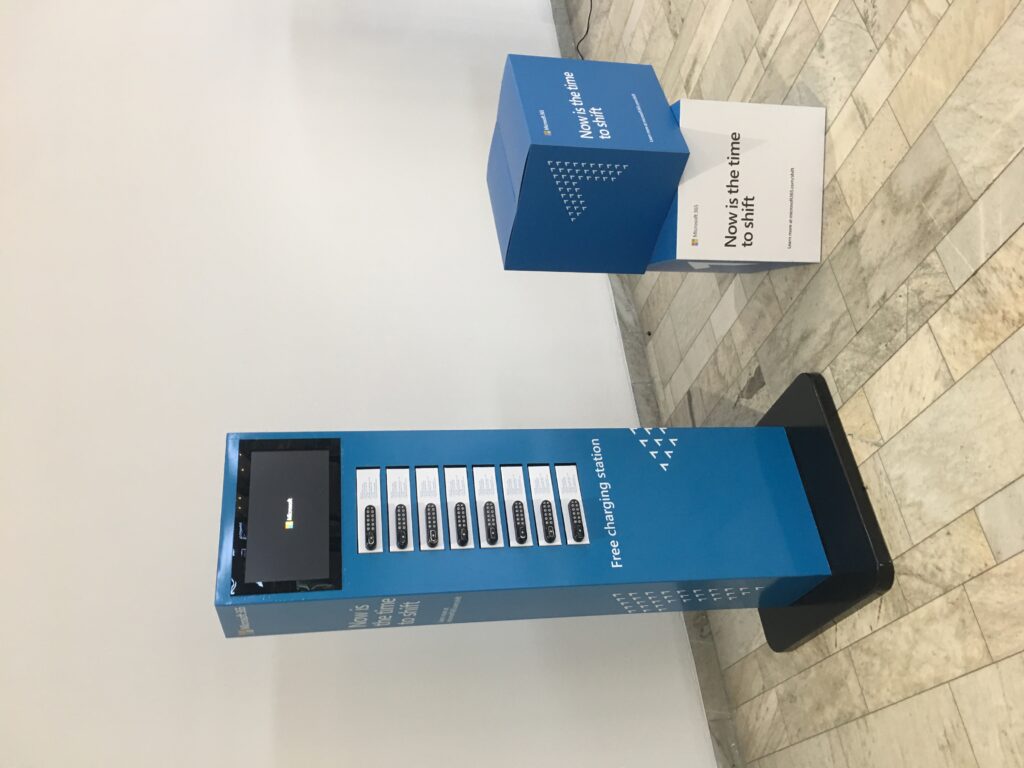
3. Types of events that benefit from phone charging stations
Whether to rent or purchase is a separate decision from whether attendees need charging. As a general starting point, temporary events often find rental easier to scope; venues that repeatedly provide the service may want to compare the full ownership cost of a permanent unit.
These are planning heuristics, not rules. Frequency, storage, branding cycles, support and delivery economics can change the answer.
Conferences
Why it matters: A delegate may use the phone for the agenda, session changes, QR check-in, networking and transport.
A full day of sessions, meetings and messages can make charging useful, especially between talks.Where it could go: Near a coffee break or networking area, in a foyer with space to pause, or beside lounge seating outside the main hall. Avoid putting a queue directly across the entrance to a session.Branding: Conference identity or a single charging sponsor can appear on the unit, subject to venue, organiser and sponsor approvals.
Keep instructions more prominent than marketing copy.Rent or buy: Renting suits a one-off congress or a series managed by an agency with changing venues. A conference centre that serves several client events each month can compare purchasing with recurring rental, including storage, maintenance and creative refresh costs.
Trade shows
Why it matters: Visitors may be on the exhibition floor for many hours, scanning information and coordinating appointments. Exhibitors also need reliable phone access for lead retrieval and staff communication.Where it could go: At an organiser-operated lounge, a central concourse, or a clearly designated networking point. Avoid placing a unit where it obstructs a booth frontage or creates an ambiguous sponsor territory.
Branding: An organiser can offer category exclusivity, a named charging lounge or a sponsor-branded unit. Define whether the sponsor receives only the physical branding or additional campaign rights.
Rent or buy: Hire is usually straightforward to evaluate for a single fair or a rotating show. An exhibition organiser or venue with recurring shows should compare total cost of ownership and the operational burden of maintaining and transporting its own stock.
Exhibitions and public showcases
Why it matters: Visitors may be using their phones for the digital catalogue, ticket wallet, maps, photography or interpretation.
Longer opening hours and dense halls can make it harder to return to a personal charger.Where it could go: In a foyer, café-adjacent waiting space or rest area that does not interfere with exhibits, circulation or conservation requirements.Branding: Use restrained creative that complements the exhibition.
A cultural institution may prefer institutional branding over a commercial sponsor, or may restrict sponsor messaging in particular galleries.Rent or buy: A temporary exhibition may use rental. A museum or permanent gallery that regularly hosts visitors can assess a permanent installation against its visitor-service plan and house rules.
Corporate events
Why it matters: Guests use devices to share contact details, review presentations, coordinate transport and communicate with colleagues. Charging can be a small hospitality detail that reduces the need to ask staff for an outlet.Where it could go: Near the registration or hospitality lounge, but not where it slows check-in or exposes the station to accidental knocks.
Branding: Corporate identity can be integrated into the shell, screen area or signage where the model allows. For an internal event, a simple instruction panel may be more useful than an external sponsor message.
Rent or buy: Rent for a single launch, awards evening or annual meeting. Consider purchase if the company runs frequent events and can manage storage, servicing and transport between sites.
Festivals
Why it matters: A long day, outdoor movement and reduced access to personal charging can make a reliable charging point useful. Phones may be used for maps, schedules, entry and messages, but a charging station must be planned for the real site conditions.
Where it could go: In a staffed or monitored rest area, a sheltered venue zone, or a powered hospitality area with adequate circulation. Do not position a general indoor unit outdoors without confirmation that it is suitable for that environment.Branding: A festival partner might sponsor a charging tent or lounge. The creative should remain legible in changing light, visible from the approach and consistent with the event’s advertising rules.
Rent or buy: Hire fits a seasonal event and avoids permanent storage, if the supplier can confirm delivery, setup, operating conditions and support. A festival operator running multiple events may model a purchase, but should include weather protection, transport, storage and maintenance.
Brand activations
Why it matters: A charging station offers a practical reason to approach a branded area. It can create a pause in a visitor journey, but not a guarantee that people will engage with a campaign.
Where it could go: Within the activation footprint, with an unobstructed queue and an optional QR interaction placed where it can be noticed without blocking the charging process.Branding: Creative can use the station itself, a backdrop, floor graphics or nearby signage. Check what surfaces can actually be customised and what the artwork deadline is.
Rent or buy: Rental is typically the more flexible route for a short campaign. Purchase is worth comparing where the brand has a repeatable activation calendar and the unit can be stored and re-skinned responsibly.
Networking events
Why it matters: A phone helps attendees follow up on introductions and coordinate meetings. A charging point near a lounge can support a natural pause.Where it could go: On the edge of a seated networking area, not in the main circulation path or beside the loudest audio source.Branding: A sponsor can name the area or support the service, while the organiser keeps networking the main purpose of the space.Rent or buy: Rent for occasional receptions. Venues and business communities with recurring gatherings can evaluate permanent provision.
Hotels and conference venues
Why it matters: Guests may need power in the lobby, meeting foyer, business lounge or shared workspace.
A venue can offer charging as a recurring amenity rather than rebuilding the service for every event.Where it could go: Near seating or a staffed reception area, while preserving privacy and clear access to circulation routes.Branding: Venue branding may be appropriate in permanent public areas. Sponsor branding may be better limited to temporary events where the commercial arrangement is explicit.
Rent or buy: Compare purchase with recurring rental if the station will be used throughout the year. Include support arrangements, repairs, replacement cables, storage and the cost of refreshing graphics.
Sports events
Why it matters: Spectators may use phones for entry, tickets, replays, photos, directions and meeting companions. Event duration and peak-time crowd movement are key factors.
Where it could go: In a concourse or hospitality area that is approved by the venue and does not constrict movement. Do not assume equipment can be installed in seating blocks or near exits.Branding: A sponsor might fund charging as part of a broader fan-service package.
Check rights categories and the venue’s restrictions on commercial activity.Rent or buy: Rental can suit a tournament or match-day pilot. A sports venue with regular events may compare purchase, but needs an operational plan for high-volume peaks.
Universities and educational events
Why it matters: Students, speakers and visitors may use phones for timetables, campus directions, digital materials and contact.
Open days and conferences can bring unfamiliar guests to a large campus.Where it could go: Near a staffed reception, student commons, library foyer or conference area, subject to campus rules and supervision.Branding: Campus identity is often the best fit. Third-party sponsor branding should be reviewed against institutional policy.
Rent or buy: Hire works for graduations, open days or an annual conference. A campus with recurring demand can assess a durable permanent station and its accessibility, maintenance and ownership model.
Cultural events
Why it matters: Visitors may use digital tickets, audio guides, event maps and transport information. A charging point can be helpful during a long performance or multi-venue festival day.
Where it could go: In a foyer, café area or accessible public lounge, away from quiet zones and protected objects.Branding: Match the character of the institution. A low-key sign may be preferable to a fully wrapped unit in a historic or visually sensitive setting.
Rent or buy: Rent for a temporary festival or special exhibition; consider buying if the venue repeatedly offers visitor charging and can support its upkeep.
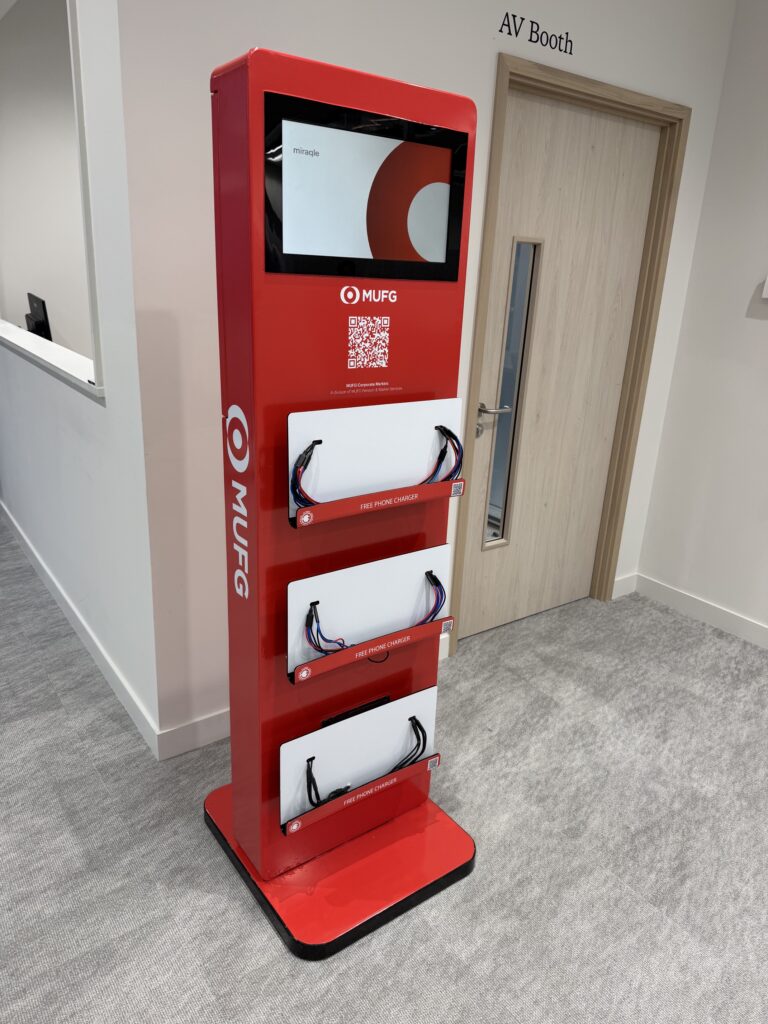
4. Phone charging stations for Swiss trade shows and exhibitions
Switzerland’s exhibition calendar spans international congresses, professional fairs, public showcases and business events. Zürich, Geneva and Basel provide examples of the variety: Messe Zürich describes spaces for trade fairs, exhibitions, corporate events and congresses; Palexpo describes an exhibition and congress centre in Geneva with modular halls and meeting rooms; and Messe Basel lists a combination of exhibition halls and conference rooms.
These venue descriptions do not determine what equipment can be installed at a specific show. Organisers must confirm floor access, installation rules and service arrangements with the venue for their own event.At an exhibition, a charging station can play two roles. Operationally, it is a visitor service. Commercially, it may be an asset in the organiser’s sponsorship inventory. Those roles work best when separated in the plan: the charging should function even if a visitor ignores the sponsor, while the sponsor should receive a clearly described and measurable set of rights.
Put the phone charging station into the floor plan, not in the leftover space
A fair floor plan usually has competing priorities: exhibitor stands, aisles, registration, catering, seminar rooms, storage, emergency routes and service access. Charging should have a designated footprint with a clear approach and a route out.
A station tucked behind a row of stands might have poor discoverability; one placed at a narrow crossing may create congestion. Choose a position by tracing a visitor journey: where does a person naturally pause, where is seating available, and where can a queue form without spilling into an aisle?A central location is not automatically the best one.
For a multi-hall show, one well-marked point per zone can be more useful than a single hub near the entrance. Conversely, many stations can create a disproportionate power and servicing burden. Use the expected visitor flow and floor layout to decide whether a central lounge or distributed charging points make more sense.
How Phone charging station can support exhibitor engagement
The unit should not be mistaken for an exhibitor lead machine. It can, however, support interactions around a wider show experience:•An exhibitor can sponsor a shared visitor charging lounge rather than asking guests to stop at a booth solely to charge.•A QR code can link to a relevant product page, programme or optional competition, provided the charging service remains usable without scanning it.•A stand team can point a visitor to the charging point as a helpful service, then invite them to a conversation when they are ready.•An organiser can include a short sponsor message on station signage and a separate, optional digital call to action.•A sponsor can support the cost of the service in return for agreed branding, placement and reporting rights.The organiser should make sponsor access explicit. Does sponsorship include a logo on the physical unit, a named lounge, a digital listing, a social mention, an attendee email or only the QR destination? Each additional placement has a different audience and approval process. Do not sell unmeasured impressions as a guaranteed quantity. If reach matters to the sponsor, define what can be counted and how it will be reported.
Example: a day-long professional fair
Imagine a two-day professional exhibition in Basel, Lausanne or Zürich with a main hall, seminar rooms and a central coffee area. The organiser maps traffic and selects a charging lounge just outside the busiest seminar transition, with seating and a clear approach. A sponsor funds the service and receives an approved wrap plus a small sign directing visitors to an optional product page. The organiser tracks basic station usage if the chosen equipment provides data, counts QR scans through a tagged link, and asks a short post-event question about awareness. This is a planning example, not a claim about any particular Swiss show or supplier performance.The same model could be inappropriate in a compact exhibition where all stands face a single narrow aisle. In that case, a quieter foyer or a few distributed units may reduce crowding. The principle is to plan for how people will actually move, not simply to select the most prominent square on the plan.
Build the operational brief for an exhibition supplier
Before requesting an event charging station rental quote, provide the supplier with: event dates and access hours; venue and hall; public opening hours; expected attendance profile; the station’s proposed use; number and type of units under consideration; whether branding is required; the design approval deadline; delivery and collection constraints; expected power access; installation and supervision requirements; and the name of the venue contact responsible for technical approval. Ask the supplier to identify any assumptions in the quote.Planning an exhibition in Switzerland? Contact Vischarge to discuss event phone charging station hire, the proposed station type, branding and the logistics for your venue. Ask for a written quotation that confirms the equipment, dates, transport, set-up scope and any support included.
5. Phone charging stations for conferences
At a conference, the most valuable location is often where delegates have a natural pause and enough time for a charge to be useful. A unit at the centre of the auditorium entrance may be visible, but it can create a bottleneck when a session ends. The foyer outside a breakout room or a lounge near coffee service may offer better dwell conditions, provided there is enough space and the venue approves the placement.
Conference halls and foyers
Do not place a station where visitors have to cross a queue to reach a seat, registration desk or accessible route. Consider what happens at peak moments: doors open, a session finishes, refreshments begin or the next session is announced. A station that appears clear during set-up may become a choke point when a few hundred people move through the foyer.Where the programme uses a digital schedule, show the station as a service on the event map. Ensure the signage uses the same location name as the app and printed floor plan. If the event has several floors or adjacent halls, include directional signage at the decision points rather than only on the unit itself.
Networking areas and hotel conferences
A charging point can be a natural addition to seating used for informal meetings. That does not mean it should be placed at every coffee table. Cable reach, table stability, spill risks and the need for wheelchair users to approach must be considered. For hotel events, clarify whether the venue controls the power supply and furniture, and whether a permanent house station is already available.
Connect charging to the digital programme carefully
Charging and event technology can support one another when the connection is relevant. For instance, a sign can point to the live agenda, a QR code can open the map, or a sponsor-supported lounge can host an optional survey. Keep these features separate from the electrical service. An attendee who does not want to scan, register or provide details should still be able to understand how to charge a phone.If charging is part of a feedback campaign, explain how the feedback will be used and how personal data is handled. Swiss data-protection guidance emphasises advance, accessible information about the collection and purpose of personal data. The event’s privacy notice and campaign design should be checked by the controller responsible for the data; this article is not legal advice.
Short conference planning example
For a one-day corporate conference in Geneva with plenary sessions and workshops, the organiser might identify two likely pause zones: a networking foyer and a quieter lounge near the meeting rooms. The team should then check actual attendee flow, accessible circulation, power access and the supplier’s station capacity. If two zones are too far apart, separate smaller stations may be more useful than a single unit, but the venue’s power and safety review should decide what is feasible. This is an example of how to reason about placement, not a universal station count.
6. Phone charging stations for festivals and large events
A festival’s scale does not automatically mean that more equipment is the answer. Outdoor sites, temporary infrastructure, weather exposure, uneven ground and large crowd movements all change the operational requirements. A product suitable for an indoor conference foyer may not be appropriate in a field, tent or open-sided structure.
Weather and site conditions
Ask the supplier in writing whether the specific unit and any power arrangements are intended for the proposed environment. Confirm what protections are needed against rain, dust, heat, condensation, direct sun and accidental impact. Do not wrap or cover a unit in a way that changes ventilation or invalidates manufacturer instructions. If the model is for indoor use only, keep it indoors or under conditions expressly accepted by its manufacturer and venue.
Power, security and operations
Coordinate with the festival’s technical production team about approved power distribution. Do not improvise electrical connections. ESTI is Switzerland’s authority for technical supervision and inspection of electrical installations; event organisers should coordinate with the venue and qualified electrical professionals on installation requirements and approvals. The exact arrangement depends on the venue and equipment, so a generic article cannot substitute for a site-specific electrical plan.Decide who checks the station during the event, who responds to an outage, how visitors retrieve a phone from a locker if a code or door fails, and how a queue will be moved if it blocks a route. For an unstaffed site, ask what the supplier and organiser each consider their responsibilities. A staffed charging area may increase operational cost, but can make user support and retrieval more direct.
Queue management and accessibility
A charging area should not depend on people standing shoulder-to-shoulder in a narrow tent. Mark a queue boundary, leave turning space and keep exit paths clear. Plan for seated users and visitors with mobility aids. Place instructions where a person can read them without stepping into the queue. If the festival runs after dark, lighting and legibility matter.
Branding at large events
Branded charging can be visible in a festival environment because guests approach with a practical need. At the same time, the surrounding creative should be robust, readable at a distance and consistent with the event’s sponsor agreements. Ask the sponsor to approve the final design and agree who is responsible for production, installation and removal.An indoor station in a controlled lounge may be better than attempting to put a device in a general outdoor zone. The right answer depends on the site map, weather and infrastructure, not simply on the event category.
7. Branded phone charging stations
Branding turns a charging unit into a visible touchpoint. It may carry the event identity, an organiser’s campaign, a sponsor’s logo, a product message or a call to action. The practical service remains the reason people approach it; the branding gives that interaction a visual context.
Branding surfaces and formats
Before promising a design, identify which parts of the particular station can be customised. Common possibilities include:
•The equipment casing: a panel, shell or replaceable graphic can carry a logo and campaign visual.
•The locker doors: where the model permits it, repeated doors can carry a cohesive design, but small graphics may be difficult to read from a distance.
•The screen or digital display: this can accommodate short instructions or approved campaign content if the station actually includes a display and the content is configurable.
•A nearby backdrop or sign: this may increase visibility without changing the equipment itself.
•Floor or wayfinding graphics: these help people find the station but must comply with venue rules and avoid becoming trip hazards.
•A QR code: this can link to a campaign landing page, programme or sponsor content. It should be tested on real devices and positioned where a visitor can scan it without blocking the service.Not every unit offers every surface.
Vischarge lists customisable branding for several of its charging products and promotes branded hire on its Swiss site.
Confirm the exact model, printable area, artwork dimensions, production lead time and approval steps before designing campaign creative.
Design it for readability and use
A common creative mistake is to treat the equipment like a small billboard and fill every surface with messages. Visitors need to identify the station and understand how it works before they can consider a sponsor message. Give the service name and key instructions enough contrast and prominence.
Use one principal sponsor identity, a short line of copy and a clear action. If there is a QR code, include a brief explanation of what will open and whether scanning is optional.Create the artwork from the supplier’s current template rather than a photo or a generic layout. Verify final dimensions, bleed, safe areas, colour settings, material finish, logo files and the proofing process.
Agree whether the sponsor, organiser or supplier approves the final artwork. If the event is multilingual, plan the instructions in the languages relevant to the audience; a small icon can supplement, but should not obscure, written instructions.
Event branding versus sponsor branding
Event branding can make the unit feel like part of the event’s service offer. Sponsor branding can fund the installation or make it more commercially valuable.
These approaches can coexist, but the hierarchy should be explicit. The event identity may appear on the station and a sponsor logo on an adjacent panel, or a sponsor may own the named charging lounge while the organiser retains the right to set service standards.
Resolve conflicts early. Check whether the event has a category-exclusive sponsor whose rights overlap with the proposed charging partner. Confirm restrictions on competitor logos, product claims, public-sector or university advertising, and branding in particular halls or rooms. A sponsor’s permission to appear on the charging kiosk does not automatically grant permission to use the event’s name, photography, attendee data or other sponsor inventory.
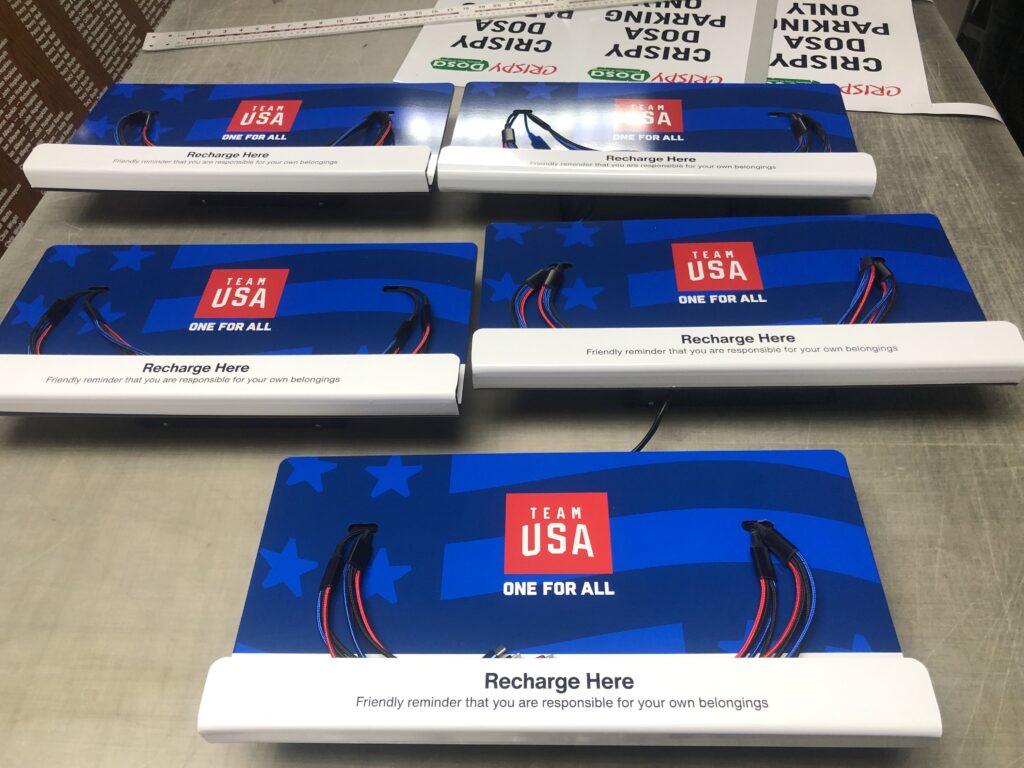
8. Turning a charging station into a sponsorship opportunity
A useful sponsorship idea can be described as utility + visibility + brand interaction. The utility gives a visitor a reason to approach. Visibility makes the sponsor recognisable in the space. Interaction creates an optional next step, such as a product page or conversation. Each part has value only if the service works and the sponsor’s rights are clear.
Exclusive charging partner
One brand becomes the event’s exclusive partner for the charging service. The package might include a logo on the units, a listing in the event app and a mention on the wayfinding map. Exclusivity is a rights decision: specify the product category, geography, event dates and any carve-outs. Do not use the phrase “exclusive charging partner” unless the organiser has checked that no other existing contract grants overlapping rights.
Charging station sponsor
A sponsor funds or supports one or more charging stations and receives agreed branding. This is the simplest model to explain to attendees. The organiser should describe what the sponsor receives—such as one branded kiosk and a logo in the online programme—rather than saying vaguely that the sponsor “owns the charging experience”. The sponsor does not own attendee data or the user’s device simply by supporting the service.
Sponsored charging lounge
A lounge can combine seating, charging and a sponsor identity. The package may also include refreshments, a meeting point or a small demonstration area, subject to venue rules. The organiser should budget for furniture, staffing, cleaning, power and production if these are part of the concept. A sponsor-backed lounge is more than a wrapped kiosk, so the value proposition and cost should describe the full installation.
QR-code activation
A station can include a QR code that leads to a landing page or optional campaign. Keep charging instructions distinct. Do not require an attendee to submit marketing information just to use the charging facility unless there is a legitimate, disclosed reason and the terms have been reviewed. Test the code under actual venue lighting and mobile network conditions. Include a short, trackable URL as a fallback when practical.
Lead-generation activation
Charging can sit within a broader campaign: for example, a product demonstration nearby, a short survey, a competition with clear terms, or an invitation to a sponsor’s stand. The call to action should be relevant and proportionate. A guest who is waiting for a phone should not be trapped into a long form or pressured to interact. If a competition asks for contact details, provide the rules, purpose, retention period and privacy information at the point of collection.
Make the package measurable, not inflated
Before the event, agree how to report usage and exposure. Could the selected station report sessions? Can the QR link be tracked? Will staff record visitor interactions? Are there defined logo placements? Does the sponsor expect a post-event report? Specify the measurement source and its limits. A scan is not automatically a qualified lead, and a logo being displayed is not a verified impression count.A good sponsorship one-pager can include: the service concept; location; event dates and hours; station format; expected branding surfaces; optional digital interaction; sponsor category and exclusivity; accessibility and service commitments; measurement method; creative deadline; and items not included. This keeps sponsor expectations realistic and helps the organiser price the opportunity coherently.
9. How charging stations can support event lead generation
A charging point may provide a context for an optional interaction, but it should not turn a practical amenity into a data gate. Separate the service from the campaign. An attendee should be able to charge without being obliged to scan a code, subscribe to a newsletter or disclose a name, unless that data is genuinely necessary for the service and that necessity is explained.
Possible campaign elements include a QR code to a sponsor landing page, a product-information page, a competition, an event survey, an optional newsletter sign-up or a link to book a meeting. These are examples, not functions automatically supplied by a charging station. The organiser or sponsor must create and manage the digital destination, content, response and data handling.
Keep consent and privacy understandable
In Switzerland, the Federal Data Protection and Information Commissioner says that people should be informed in advance, in an adequate and accessible manner, when their personal data is collected. Information should cover matters such as who is responsible, the purpose, recipients where applicable and, depending on the situation, retention and destination state.
This guide is not legal advice, and a campaign may also have to consider rules in other countries depending on the people and processing involved.A practical event workflow should therefore answer these questions before a QR campaign goes live:
1.Who is the data controller? Name the organisation that decides why and how the data is processed. If a sponsor receives the information, make that explicit.
2.What is being collected? Ask only for fields needed for the stated activity. A charging service ordinarily should not need a phone number, email address or marketing profile simply to provide power.
3.Why is it collected? State the immediate purpose in direct language. If the information will be used for future marketing, explain that separately and obtain any required permission.
4.Who receives it and where does it go? Identify relevant sponsors, service providers or cross-border transfers in the privacy information, where applicable.
5.How long is it kept? Set a retention period connected to the stated purpose and remove information that is no longer needed.
6.How can a person make a choice? Avoid pre-selected marketing options. Make optional communications genuinely optional and record choices in a way the responsible organisation can honour.
The FDPIC’s explanation of the duty to provide information is a useful starting point for a campaign owner. The organiser should ask its privacy lead or legal adviser to review the actual form, privacy notice and data flow, especially if a sponsor collects data directly.
Measure without collecting personal information unnecessarily
For an initial sponsorship report, aggregate data may be enough: station sessions, approximate peak-use periods, QR scans and survey responses. Avoid trying to identify individual visitors unless there is a clear purpose and legal basis. Do not capture device identifiers, email addresses or contact details merely because a QR platform can do so. A campaign can often measure attention without tying each interaction to a named person.
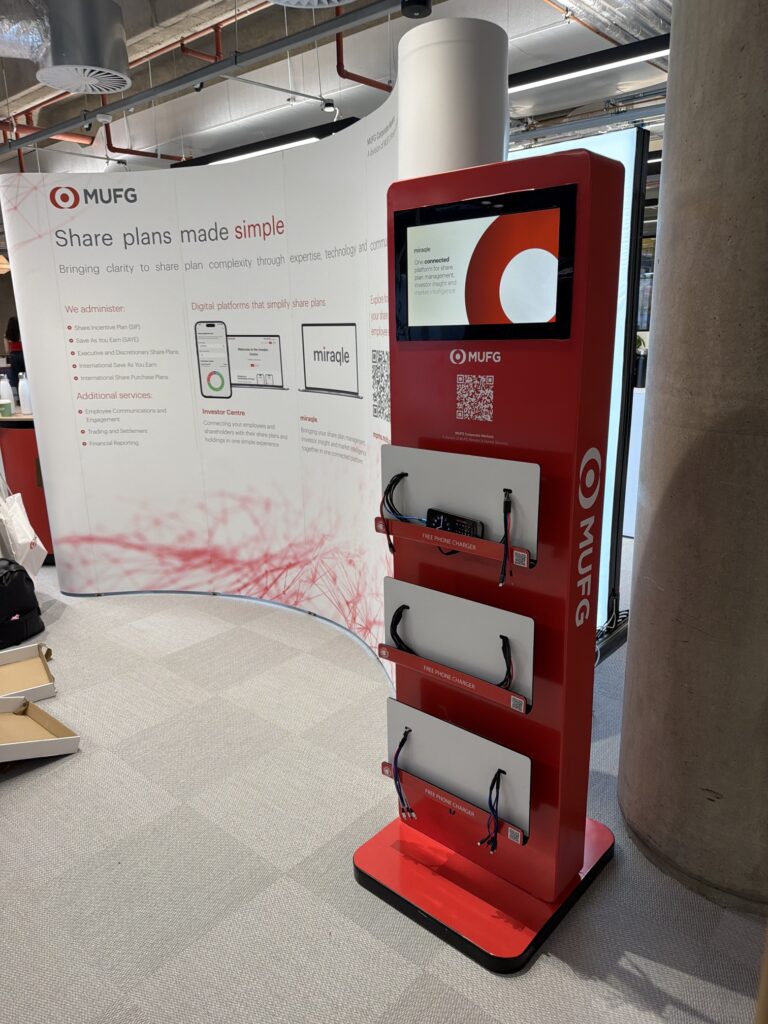
10. Where should you place charging stations at an event?
Placement shapes visibility, convenience, queue size, accessibility and sponsor value. Begin with the attendee journey, then test candidate locations against the venue plan and technical constraints. The best position is rarely determined by foot traffic alone.
Locations to consider
Registration or entrance: This is easy to find and useful for a quick arrival top-up. It can also be crowded at peak entry. Keep charging separate from ticket scanning and bag checks.Networking areas:
Visitors may have time to pause and use a station. Place it near, rather than inside, a main conversational circle so the unit does not interrupt introductions.Coffee-break spaces: Natural waiting periods can make charging convenient. Coordinate with catering to avoid crossing queues, spill areas or tray-return routes.
Exhibition halls: A central visitor lounge can provide a service and sponsor location. Check aisle widths, stand boundaries, organiser rights and service access.Lounges and seating areas: Seating supports longer use and reduces the number of people standing around the unit. Ensure cables do not trail into circulation.Restaurants: Charging can be useful during a meal, but the station should not interfere with dining operations, cleaning or safe movement.VIP areas: A premium lounge may justify a dedicated point. Ensure the service does not displace accessibility provisions or essential seating.Conference foyers: Foyers are visible and already used between sessions.
Examine what happens when two sessions finish at once and whether the station can sit outside that surge.Hotels and venues: A permanent public-area station belongs where guests can find it, but its location should be consistent with reception, housekeeping, electrical and security operations.
Placement checklist
For each proposed point, ask:
•Can an attendee see it from an approach route, or is additional wayfinding needed?
•Is the unit close enough to a power source approved by the venue?•Does the queue fit without narrowing an aisle or blocking an exit, door, registration desk or accessible route?
•Can a wheelchair user approach the controls and use the service, or is an equivalent accessible option available?
•Is there seating or a nearby place to wait where appropriate?
•Can equipment be monitored and reached by staff without entering a restricted area?
•Is there a risk of knocks, liquid spills, vibration or interference with production equipment?
•Does the sponsor have a clear sightline without overwhelming the room or confusing wayfinding?
•Does the venue require approval, a floor-plan mark-up, electrical review or an installation window?
•Can the station be reached for setup and removal without disrupting public access?Do a physical walk-through with the venue or production team if possible. A marked-up plan helps, but it cannot always show actual sightlines, obstructions, lighting, competing queues or the way furniture changes visitor behaviour.
11. How many phone charging stations does an event need?
There is no universal ratio of stations to attendees. A total headcount does not show how many people will charge simultaneously, how long they will stay, how many devices each unit can serve, whether a charging session lasts several minutes or longer, or whether visitors can access other power points.A more useful capacity plan uses five inputs:
1.Event pattern: duration, peak periods, multi-day attendance, entry and break schedules.
2.Likely demand: phone dependence, attendee profile, existing charging access and event app usage.
3.Equipment throughput: number of usable cables or lockers, average time per session and any operational limit supplied by the manufacturer.
4.Space and location: how many zones visitors use and how far they are willing to walk.
5.Service model: staffed or unattended, locker or open, single hub or distributed points, and what happens if one unit is unavailable.
A practical planning method
Step 1: Map demand zones. Mark the entrance, session rooms, exhibition areas, food, lounges and outdoor zones. Estimate where people will actually pause, not merely where the event has empty floor area.
Step 2: Establish what is already available. Confirm socket access, venue charging points, hotel room access, attendee access to power banks and any charging included in the event infrastructure.
Step 3: Choose a service format. Lockers can serve people who want to leave a device briefly; open stations can suit visitors staying beside the unit. If attendees need power while walking around, a fixed station may not meet that need.
Step 4: Estimate concurrent use. Use prior event data if available, or make an explicitly labelled planning assumption. Ask the supplier for its usable connections, documented operating limits and recommended supervision.
A “12-locker” model, for example, describes the number of compartments, not the number of people served per hour.
Step 5: Test against peaks and failure. Consider a session change or the first hour of a festival, not only average use. Decide whether capacity remains acceptable if one unit is out of service. If usage will be measured, arrange that before the event.
Step 6: Check the footprint. A mathematically adequate number of units may not fit safely in the proposed area. Placement and circulation can constrain the design.
Illustrative planning scenarios (not standards)
The following numbers are examples for structuring a first conversation, not industry benchmarks or universal recommendations. They assume that a limited share of guests use charging at any one time. Actual requirements may be lower or higher after venue, duration, usage and equipment are reviewed.
| Event scenario | Illustrative starting point | What to test before confirming |
| Small corporate event, 80–150 guests, half-day | One modest multi-device point near a lounge, or no separate unit if power is already convenient | How many guests remain all day, whether the venue has table power and whether charging is part of hospitality |
| Medium conference, 300–600 delegates, full day | One or two points in separate pause areas | Session-change peaks, distance between rooms, break queues and actual connector mix |
| Large conference, 1,000–2,000 delegates, multi-zone | Several distributed points or a staffed charging lounge, subject to floor-plan approval | Hall geography, traffic per zone, support response and whether one location will be hard to find |
| Trade show, 5,000+ visits over a day | A central charging lounge plus possible additional zones if the site is large | Unique attendees versus total visits, hall layout, exhibitor rights, peak times and sponsor inventory |
| Festival, multi-hour outdoor programme | A sheltered, monitored point or several approved zones after an outdoor suitability check | Weather, site power, distance, security, queue control, opening hours and support coverage |
These example ranges are not claims about Swiss market norms. They illustrate why expected attendance alone cannot produce a reliable station count. Share the event schedule, map, approximate attendance, peak profile and existing facilities with the supplier and ask for the reasoning behind its recommendation.A small pilot can be useful at a recurring event.
Record the number of sessions or locker uses if the equipment supports it, note the busiest periods, ask visitors whether they found the station, and review any queue or support issues. Use the findings to change placement or capacity next time. Avoid interpreting one event’s usage as a guaranteed forecast for another venue or audience.
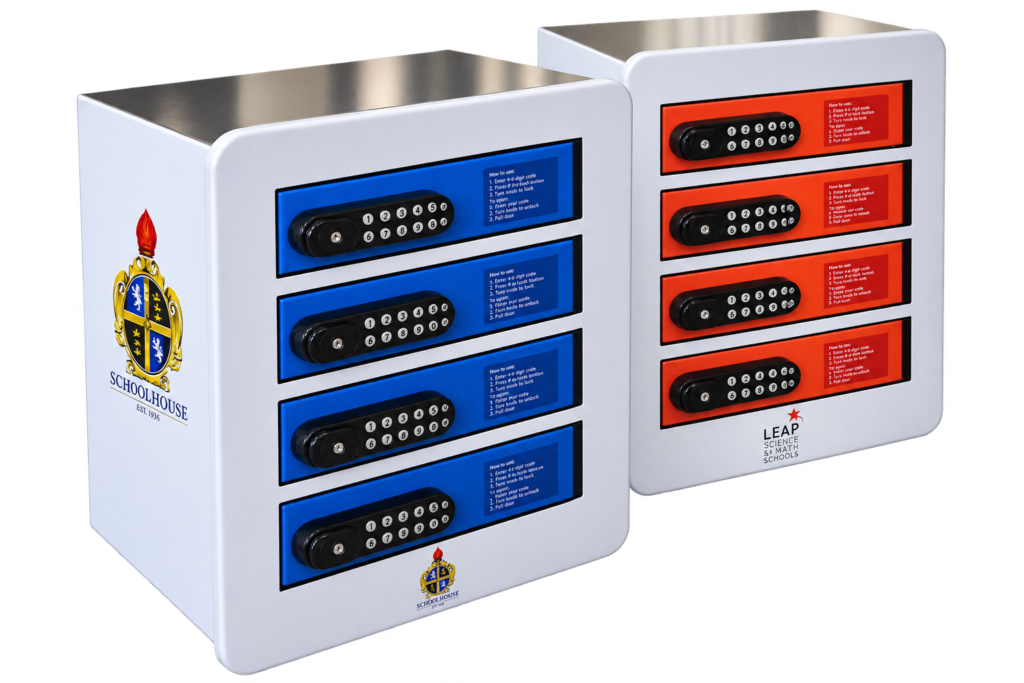
12. How much does event phone charging station hire cost in Switzerland?
There is no responsible way to quote a reliable Swiss rental price without the specification and event details.
Vischarge does not provide a verifiable standard rental price in the source information reviewed for this article, so no figure is stated here. Request a written quote for the actual dates, model, location and service scope. A quote may depend on:
•Quantity and equipment type: a locker, open multi-device station, table or custom configuration can involve different equipment and transport needs.•Rental duration: event days, delivery windows, rehearsal access and overnight periods may affect the rental period.
•Delivery and collection: city, access hours, vehicle restrictions, loading bay booking and distances inside the venue can change logistics.
•Installation and removal: clarify whether the supplier delivers to the event entrance, moves the unit to its final position, connects it, tests it and later removes it.
•Branding and customisation: artwork preparation, print production, proofs, re-branding, rush production or unique wraps may be priced separately.
•Staffing and support: a staffed service, on-site attendant, standby technician or remote support arrangement is different from equipment-only hire.
•Event location: a venue in Zürich, Geneva, Basel, Bern, Lausanne, Lucerne, Zug, St. Gallen or Davos may have different transport and access requirements
•Power and safety planning: any extra technical work, approved distribution or venue-specific processes should be scoped by the appropriate parties.•Insurance, damage and loss terms: clarify who is responsible for equipment during transit, installation, operation and storage.•Taxes and quote validity: confirm currency, applicable taxes, quote expiry and payment schedule in writing.
How to compare quotes fairly
Ask each supplier to price the same brief. Request the exact model and quantity, event dates, delivery and collection window, branding scope, setup responsibility, operating support, power assumptions, cable configuration, user instructions, insurance terms, cancellation terms and any charges not included. If an essential item is not priced, ask for it to be identified as an assumption or optional extra.A lower line-item price may exclude delivery, custom graphics, on-site help or a suitable locker format. A higher quote may include elements that another supplier omits. Compare the total delivered service, not only the rental of the hardware.Need an event phone charging station rental quote in Switzerland?
Contact Vischarge with your event date, city, venue, expected attendance, schedule, preferred format and branding requirements. Ask for the complete scope and any exclusions in writing.
13. Rent or buy a phone charging station?
Rental and purchase solve different operational problems. Hire gives an organiser temporary access to equipment for a particular event. Buying gives a venue or business an asset it must deploy, maintain, store and refresh. Neither is inherently better.
| Factor | Rent or hire | Buy |
| Upfront cost | Usually scoped to the event or rental term; ask what delivery and services are included | Higher initial purchase outlay; compare with expected use and total ownership cost |
| Flexibility | Useful when event formats, locations or quantities change | Best when a consistent model can serve recurring needs |
| Ownership | Equipment remains with the supplier | The buyer owns the asset, subject to contract and warranty terms |
| Storage | Typically handled by the supplier outside the hire period | The buyer must store, protect and track the equipment |
| Maintenance | Confirm who supports the unit during the rental and what happens if it fails | The buyer plans routine checks, repairs, spares and end-of-life replacement |
| Branding | Event-specific artwork may be available; confirm production and removal details | Permanent branding can be used repeatedly, but campaigns may require new wraps or panels |
| Frequency of use | Appropriate for a one-off or occasional event | More plausible when use is frequent enough to justify ownership costs |
| Logistics | Supplier may coordinate event delivery and collection, depending on the quote | The owner handles transport between sites unless a service agreement covers it |
| Long-term value | Costs recur with each hire; service may avoid owning idle equipment | Value depends on utilisation, useful life, support and resale or replacement assumptions |
Renting can make sense when
•The event is one-off, seasonal or occasional.
•An agency supports different clients and changing creative.
•The venue, event size or station format has not yet been proven.
•The organiser does not want to store or maintain equipment between events.
•A supplier’s event support or logistics are valuable to the production team.For a rental, read the contract for delivery and collection windows, setup responsibility, damage, cancellation, access, support and branding. Ask whether the quoted model is guaranteed or may be substituted. Clarify who deals with a faulty cable or inaccessible locker while the event is open.
Buying can make sense when
•A hotel, venue or university intends to offer charging repeatedly.
•A conference centre has a predictable, recurring service requirement.
•An exhibition company uses the same type of equipment at several events.
•The business can store, transport, inspect and service the equipment.
•A consistent brand or visitor-service experience is valuable across locations.Ownership calculations should include more than purchase price. Add delivery, installation, any necessary venue work, storage, staff time, maintenance, replacements, insurance, graphic changes and the cost of keeping the model compatible with current devices. Check warranty language and service support in the quote; do not assume a web-page promotion applies to a specific transaction.
A venue may also use a hybrid model: own a basic permanent station for everyday use and hire additional units for a large annual event.
This spreads the purchase across regular use while preserving temporary capacity. Compare the real annual cost, including the effort of managing two equipment streams.Looking for a permanent charging solution for a venue or business?
Explore Vischarge’s listed charging station products and ask for a configuration and written price appropriate to your location and use.
14. What to look for when choosing an event charging station
Use this buyer’s checklist in a supplier conversation. Ask for answers specific to the proposed model, not generic marketing language.
Capacity and compatibility
•How many devices can be connected or stored at once?
•How many usable charging connections are there per user or compartment?
•Which connector types are included, and can they be replaced?
•Does the model support wireless charging, and which devices can use it?
•Can a visitor use their own cable if the attached option is unsuitable?
•What happens when all connections are in use?
•Are tablets or larger devices in scope, or phones only?
Security and user experience
•Does the unit have lockers? How are they locked and reopened?
•What is the recovery process if a code is forgotten or a locker does not open?
•Can a device be left charging without supervision, and what wording should visitors see?
•Is there a display, and can instructions or campaign content be configured?•Is an attendant included or available as an extra?
•How is the unit reset or checked between sessions?
Physical and technical fit
•What are the dimensions, weight and footprint?
•Is it freestanding, wall-mounted or table-top, and is installation included?
•What power supply and connection does it require?
•What ventilation, spacing and environmental limitations apply?
•Can it be used indoors, outdoors or only in a specified protected environment?
•How should cables be managed to avoid loops, strain and trip hazards?
•Can the unit be moved after it is set up, or does relocation require technical assistance?
Branding and service
•Which surfaces can be branded and what are the exact artwork dimensions?
•What are the production lead time, proof process and file requirements?•Are artwork production, installation and removal included in the quote?•What delivery, collection and setup windows are available at the venue?
•Is event-day support included, and how quickly can a fault be addressed?•What spare cables or replacement parts are provided?
•What warranty, service contract, insurance and damage terms apply if purchasing?
•Does the supplier provide usage data? If so, what does the metric count and how is it collected?The supplier should be able to distinguish a product specification from a recommendation and from an optional service. If a feature matters to the event, include it in the written quote and agreement rather than relying on a verbal assumption.
15. Safety, security and venue considerations
A charging station is electrical equipment in a public or semi-public setting. Plan it with the venue’s technical and operations teams.
The Federal Inspectorate for Heavy Current Installations (ESTI) is responsible for technical supervision and inspection of electrical installations in Switzerland, including defined functions related to low-voltage products and permits.
The legal and technical requirements for any particular installation depend on the circumstances; this guide does not provide an electrical design or substitute for advice from the venue or qualified professionals.
Cable management and trip hazards
Keep the unit close to its approved power source. Do not run unsecured leads across public paths or conceal a cable in a way that conflicts with venue requirements. Use only a cable-management approach accepted by the venue and installation team. Keep the floor around the unit clear and inspect it during the event, especially after furniture or queue barriers move.
Stability and ventilation
The unit should be on a stable surface and positioned so it cannot be easily struck by a trolley, door or crowd movement. Follow the manufacturer’s instructions for clearances and ventilation. Do not drape fabric, sponsor panels or decorations over vents. Keep drinks and wet cleaning equipment away from electrical components.
Fire and emergency planning
Ask the venue what equipment and placement rules apply, where emergency routes and exits must remain clear, and what to do if a unit overheats, emits an unusual smell or becomes damaged. Do not open electrical housings or attempt a repair unless authorised and qualified. Staff should know how to report a fault and whom to contact.
Security and responsibility
For lockers, explain what is and is not protected. A lockable door does not necessarily mean an insurer or venue treats the unit as a secure safe. State any user terms clearly and provide support contact details. For open stations, say whether visitors should remain with their devices. Agree who monitors the station, who responds to lost property or locker-access problems, and how unresolved devices are handled after closing.
Accessibility and venue rules
Preserve accessible routes and provide an approach that does not require a guest to reach across a queue. Consider viewing height, controls, legibility, cable reach and a seated user’s ability to interact. Ask the venue about approved floor plans, loading, permitted fixing methods, branding, power, setup times, security and removal. Venue approval should be obtained before public installation.
Outdoor and temporary locations
Do not assume an indoor station is weatherproof. Confirm the equipment’s approved operating environment with the manufacturer or supplier and coordinate any temporary power installation with competent professionals. If the venue changes the proposed location because of weather, access or crowding, the replacement location should receive the same safety and accessibility review.
16. Event charging stations and the attendee experience
Good event charging is easy to find, easy to understand and integrated into the event layout. The experience begins before a visitor reaches the unit: a map or sign points to it. At the unit, instructions explain how to use it, which devices are supported and whether a phone can be left. Around the unit, the space offers enough room to wait without interrupting someone else.
Convenience without friction
A station can reduce the effort of finding a wall socket or asking staff for help. It can also introduce friction if the queue is long, the cable is unfamiliar, the locker process is unclear or the unit is out of order. Treat user testing as part of preparation. Ask someone who did not help plan the installation to follow the instructions, charge a test device and retrieve it without coaching.
Create a useful pause, not an unwanted bottleneck
Seating, clear signage and nearby services can make a charging point comfortable. But a station should not force visitors to wait in the middle of a busy foyer or make them choose between charging and attending a session. If people are likely to stay for a longer period, consider whether the space has enough seats and whether the event has a nearby quiet or networking area.
Hospitality and digital engagement
A branded lounge can link charging with hospitality, networking or sponsor content. Let the visitor decide how much to engage. A clear sign that says “Phone charging—scan for the event map” is more transparent than a QR code with no explanation. The service should continue to work if the attendee declines the digital interaction.The event team should also provide a non-digital way to learn where charging is available, such as a printed map, staff information or a sign at registration. Digital-only wayfinding is less helpful to a person whose phone is already low on power.
17. Charging stations as event marketing assets
A charging unit can be one part of an event’s marketing environment. It may offer a repeated visual presence while guests use the service, provide an optional digital destination and give sponsors a tangible contribution to attendee facilities. Those are potential benefits, not guaranteed outcomes.
Brand visibility and experiential marketing
The unit’s location, design, lighting, surrounding furniture and the length of time visitors spend nearby influence whether a brand is noticed. A highly branded station in an inaccessible corner may provide less value than a modest station placed well. A sponsor message should connect to the audience and programme rather than rely on the mere fact that attendees need power.An experiential concept could pair a charging lounge with a product demonstration or meeting space. The experience should remain clearly sponsored and should not interfere with the basic service. If a guest chooses to interact, the next step should be quick and relevant.
Social media and campaign content
A visually distinctive lounge might appear in attendee photos, but organisers should not promise social reach unless they have a defined measurement method. Do not assume a visitor will publish an image or tag a sponsor. If the campaign includes a photo opportunity, keep it optional and obtain any permissions needed for identifiable photography.
Measure a marketing asset responsibly
Potential reporting can include use counts, QR activity, campaign page visits, opt-in leads, survey feedback, sponsor staff interactions and verified placements. Define the metric before the event. Use a trackable link or UTM parameters for web traffic, but do not equate clicks with sales. Ask the sponsor what action matters and which evidence will be credible to them.
18. How to measure the value of an event charging station
Measurement should match the campaign objective. If the purpose is attendee service, usage and feedback may matter more than leads. If a sponsor paid for the activation, the organiser may report brand placements, station sessions and optional campaign activity. Avoid selecting a single proxy metric and treating it as proof of business return.
| KPI | What it may indicate | Measurement caution |
| Number of charging sessions | How often the equipment was used | Confirm how the equipment defines a session and whether incomplete attempts are counted |
| Utilisation by time period | When demand peaked | Use a consistent time window and be aware that one unit’s logs may not capture every interaction |
| Locker occupancy or turnover | Use of lockable compartments | Occupancy does not automatically show unique people or satisfaction |
| QR scans | Interest in the digital destination | A scan is not a lead, purchase or verified person |
| Landing-page visits | Campaign traffic from the station | Filter bots and duplicates where possible; use a tagged link consistently |
| Leads generated | Contacts submitted through an optional form | Define a qualified lead and document consent and source attribution appropriately |
| Sponsor interactions | Conversations or campaign actions | Staff tallies can be subjective; agree a simple counting method |
| Brand impressions | Potential exposure to a placement | Use only a stated, defensible model; do not call estimated passers-by measured impressions |
| Attendee feedback | Whether guests found charging useful and easy | Response bias matters; keep questions short and report the number of responses |
| Operational incidents | Faults, queues, accessibility or safety issues | Record incidents promptly and review them alongside usage |
A compact post-event report can contain the event context, station model and location, service hours, usage data source, any outages, QR results, survey response count, campaign outcomes and recommended changes. Distinguish raw counts from estimates. If a supplier provides analytics, ask how the data is produced, whether it is aggregated, what identifiers are used and how long it is retained.
19. Common mistakes when hiring event charging stations
Ordering too few units from attendance alone. A high headcount does not mean everyone charges at once, but it does not account for multiple zones or peak moments either. Map demand and ask how capacity is defined.Putting the station wherever there is spare space. A leftover corner may be invisible, inaccessible or far from power. Select a location intentionally and review it with the venue.Treating branding as the whole experience. Attractive graphics cannot compensate for unclear instructions, incompatible cables, a long queue or a faulty unit. Make usability the first design priority.Ignoring venue requirements. A supplier may know its own equipment but not the venue’s loading rules, approved power, floor-protection policy or branding restrictions. Put the venue contact in the planning loop.Underestimating power and installation needs. Do not guess at electrical capacity or add improvised connections. Confirm the equipment requirements and have the venue or qualified professional approve the arrangement.Forgetting accessibility. A station placed in the path of movement or with controls out of reach can create a barrier. Review approach space, queue layout, instructions and alternatives.Assuming a locker is a complete security guarantee. Confirm lock method, retrieval support and user terms. Explain the service accurately to attendees.Choosing solely on rental price. Compare exact equipment, branding, transport, setup, support, insurance and cancellation scope. A low headline figure may not represent a delivered service.Allowing too little setup time. Venue access, safety checks, power approval, branding proofs and delivery slots may all need coordination. Include setup and testing in the production schedule.Failing to test connectors and instructions. Ask to test the unit or review a clear demonstration. Check the connector mix, device fit and lock recovery procedure before doors open.No contingency plan. Know who responds if the unit loses power, a cable fails or a locker cannot be opened. Have an escalation route and a safe way to close the service if required.Making charging conditional on marketing data. This can erode trust and may be inconsistent with the event’s privacy commitments. Separate the amenity from optional campaigns and explain data collection transparently.
20. Event phone charging station checklist for 2027
Use or adapt this checklist for an internal production brief. Mark each item as confirmed, pending or not applicable.
Before booking
Define the event problem the station should solve: visitor convenience, venue amenity, sponsor activation or another clear purpose.Confirm event type, dates, public hours, venue, city, attendance estimate and audience profile.Map halls, stages, registration, food, seating, accessible routes and likely charging zones.Identify existing charging points and other available power.Decide whether visitors should remain beside a device or use individual lockers.Confirm the proposed unit’s usable capacity, connector options, dimensions and environment limits.Ask whether branding, a display, wireless charging or usage reporting is supported by the specific model.Compare rental with purchase if use may recur.Request a written quote listing delivery, collection, setup, branding, staffing, support, taxes, exclusions and cancellation terms.Check event sponsorship contracts and confirm which brand rights can be sold.Identify the venue’s technical, accessibility, security and marketing contacts.Confirm the event’s data-protection owner if QR scans, competitions, surveys or lead forms are planned.
Before the event
Obtain venue approval for the location, power and floor plan.Approve the supplier’s exact model and configuration in writing.Finalise and proof artwork using the supplier’s current template.Agree who approves sponsor marks and campaign copy.Confirm delivery and collection time, loading access, lift requirements and contact numbers.Schedule installation and removal around venue access windows.Confirm any qualified electrical review or installation support required by the venue.Prepare wayfinding for the app, programme, website or printed map.Write short user instructions and support contact details.Prepare a fault, locker-retrieval and lost-property procedure.Test all available charging methods with representative devices and accessories.Check that the QR link works and the privacy information is visible before any personal data is collected.Decide how usage, feedback, scans and incidents will be recorded.
During setup
Check that the delivered unit matches the quote and is undamaged.Install only at the approved location and use the agreed power arrangement.Confirm that cables are secured and do not cross public routes.Keep exits, emergency equipment, accessible paths and service access clear.Check stability, ventilation, signage, lighting and queue space.Test charging with more than one type of device.Test every locker access method, including the recovery process where practical.Walk through the visitor experience without staff coaching.Take setup photos for the event record and sponsor report, observing any venue rules.Record the supplier and venue escalation contacts where event staff can find them.
During the event
Check the station at agreed intervals for power, cable damage, blocked access and cleanliness.Keep the queue within its marked area and adjust barriers if the flow changes.Ensure signage remains visible after furniture or sponsor displays move.Respond promptly to faults and tell visitors if the service is temporarily unavailable.Do not attempt unauthorised electrical repairs.Provide help for locker access issues using the agreed procedure.Record meaningful usage counts, downtime, peak periods and recurring questions.Keep QR interaction optional and consistent with the published privacy information.Escalate safety concerns to the venue or qualified professional immediately.
After the event
Check that all devices and event materials have been removed from the area.Arrange return, collection or storage in line with the supplier agreement.Note faults, damage, incidents and any unresolved property issues.Collect available station metrics and confirm how they were counted.Review QR scans, leads, feedback and sponsor activity without overstating attribution.Delete or retain personal data according to the responsible organisation’s privacy policy and retention plan.Compare actual usage and operational effort with the original plan.Record changes needed for the next event: capacity, location, signage, accessibility or staffing.Close sponsor reporting with the agreed evidence, metric definitions and caveats.
21. Why Swiss event organisers should plan charging early
Charging touches multiple parts of event production, so it is easier to integrate early than to squeeze in late. A station can affect the floor plan, power arrangements, sponsor package, artwork schedule, delivery plan and accessibility review. Early planning does not guarantee a particular supplier or price; it gives the organiser time to compare options and settle requirements.
Layout and technical review
A venue plan can reserve space before exhibitor stands and catering are finalised. The technical team can review power and installation assumptions. The operations lead can check queuing and safety. If an indoor unit is being considered for an outdoor location, the environmental question can be resolved before the event schedule is fixed.
Sponsorship and branding
Charging sponsorship may compete with other category rights. Identifying the opportunity early lets the organiser check exclusivity, define sponsor deliverables and agree artwork approvals. It also gives the creative team time to use supplier templates and proof the actual printed design.
Logistics and budget
The quote can cover the full service rather than equipment only. Delivery access, event hours, installation windows, staffing and removal can be costed alongside the unit. The organiser can then decide whether rental, purchase or a hybrid model fits the event’s needs. For recurring shows, early review can compare the ownership burden with repeated hire over a realistic period.
Supplier brief
A useful enquiry includes event location and venue, date and access hours, expected attendance, event format, proposed locations, required branding, power assumptions and whether staffing or data reporting is wanted. If the plan is uncertain, say so. A supplier can respond more usefully to a transparent brief than to a request for a number based only on attendance.
22. Vischarge: event phone charging solutions in Switzerland
Vischarge’s Swiss website describes phone charging station hire for events, with locker and non-locker options, and lists branded station products for sale. Public product information includes a non-locker station described as having 12 charging cables, lockable four- and twelve-compartment products, and branded charging options. Product details and promotional statements on the live website can change; confirm the available model, configuration, price, warranty, delivery, artwork, support and rental terms directly before making a decision. For a temporary event, share the location, venue access rules, event dates, attendee estimate, programme hours, proposed placement, desired cable or locker format, and branding deadline. Ask for a written quote that states what is included and what remains the organiser’s responsibility. If the venue requires technical documentation or approvals, include that in the request.For a permanent installation, describe the setting and expected frequency of use. A hotel, conference centre, university, office or public venue should ask about dimensions, mounting, power requirements, operation, support, maintenance, storage of any spare equipment and the terms of any warranty or service contract. The supplier’s product page should be checked against the exact configuration in the quotation.Planning an event in Switzerland? Contact Vischarge to discuss phone charging station hire for your venue and dates. Need a permanent station? Explore the products listed by Vischarge and request current specifications and pricing.
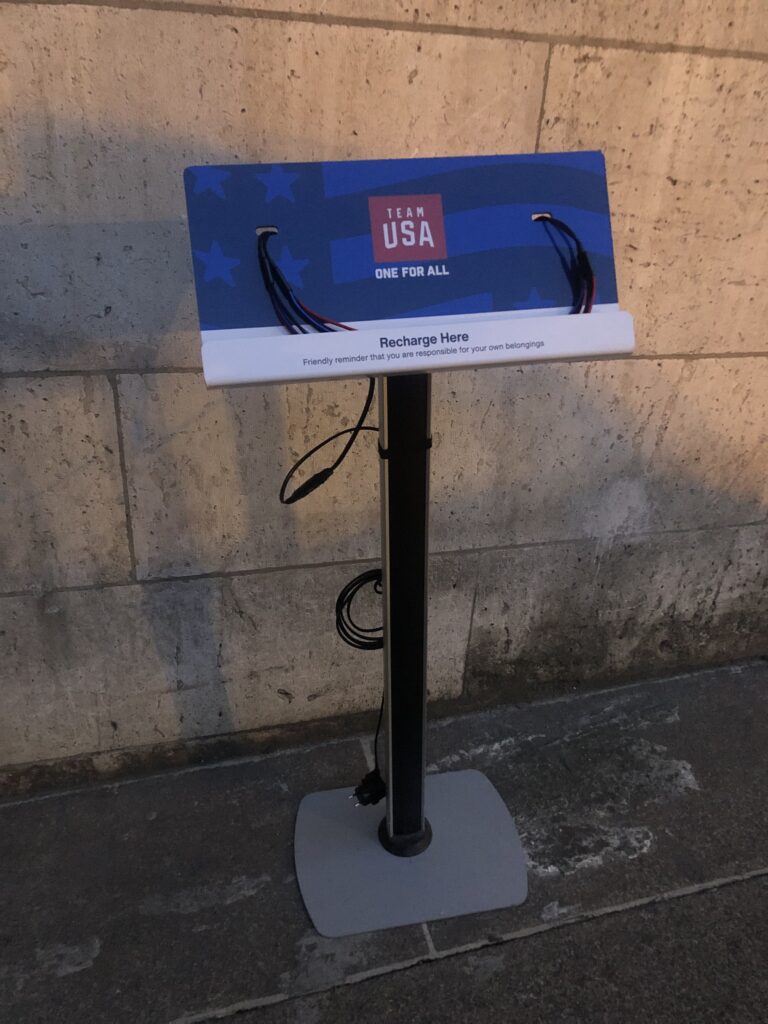
23. Frequently asked questions
1. What is an event phone charging station?
It is a shared unit that lets event visitors charge phones at a designated point. Depending on the model, it may provide open cables or ports, a charging table, or lockable compartments. The organiser should confirm the specific configuration and its intended environment.
2. How does an event charging station work?
The unit receives power through its specified supply and presents charging connections or compartments for users. Some models allow a visitor to remain beside the phone; locker models let a visitor store it temporarily using the unit’s access method. Instructions, supported connectors and retrieval procedures vary by product.
3. How much does it cost to rent a phone charging station in Switzerland?
The price depends on model, quantity, dates, delivery, location, setup, branding, staffing and support. No verified standard Vischarge rental rate is provided in this guide. Send the supplier the event details and request a written, itemised quote.
4. How many charging stations does an event need?
There is no universal attendee-to-station formula. Consider event length, peak demand, the number of event zones, existing sockets, unit capacity, charging session duration and whether a station will be staffed. Use the examples in this guide as planning prompts, not standards.
5. Can charging stations be branded?
Some products support branded graphics or customisable panels. Vischarge’s Swiss site lists customisable branding for products and promotes branded event hire. Confirm the printable areas, dimensions, production timing and cost for the exact unit.
6. Can a sponsor brand a charging station?
Yes, if the organiser’s contracts and venue rules allow it and the selected product supports branding. Define the sponsor’s rights, placement, category exclusivity, campaign terms and any measurement before selling the package.
7. Are charging stations suitable for trade shows?
They can be useful at trade shows where attendees are on site for long periods and use phones for event information, meetings or exhibitor details. Place them where visitors can pause without blocking aisles or stands. Confirm floor-plan and sponsorship rules with the organiser and venue.
8. Are charging stations suitable for conferences?
They may fit conferences with full-day programmes, event apps, networking and multiple rooms. A foyer or lounge near a natural break can work well if queues do not interfere with session entry or accessible routes.
9. Are charging stations suitable for festivals?
Potentially, but outdoor suitability must be confirmed for the specific equipment and location. Weather, power, security, crowd flow, lighting and retrieval support require planning. Do not assume an indoor product can be used outdoors.
10. Should I rent or buy a charging station?
Renting suits one-off or occasional events and avoids storing an asset between uses. Buying may make sense for a venue or business with recurring demand and the capacity to maintain, store and transport the equipment. Compare full costs and responsibilities rather than only rental price and purchase price.
11. Where should charging stations be placed?
Consider registration, networking areas, coffee breaks, exhibition lounges, seating areas, restaurants, VIP spaces or conference foyers. The best position has visibility and approved power, with enough room for a queue and no obstruction to emergency or accessible routes.
12. Can charging stations charge multiple phones?
Many event charging units are designed for multiple devices, but capacity varies. Check the exact model’s number of usable connections or lockers and ask how many users it can serve concurrently. Connector count does not by itself determine hourly throughput.
13. What charging cables are supported?
It depends on the model. Ask for the current cable and port list, whether cables are attached or replaceable, and what happens if a visitor’s device is not compatible. Do not rely on a general claim of universal compatibility without checking the precise configuration.
14. Do charging stations need an electrical connection?
Most fixed charging units require an approved power source, but the connection and power requirements vary. Confirm them with the supplier and venue technical team. Do not improvise event electrical work; use the venue’s approved process and qualified professionals where needed.
15. Can charging stations be used outdoors?
Only if the specific equipment and installation are suitable for the conditions. Ask about rain, dust, temperature, shelter, ventilation and power protection. If the manufacturer or supplier does not approve the planned environment, keep the unit in a suitable indoor or protected area.
16. How early should I book event charging stations?
There is no single lead time that applies to every event. Allow enough time to confirm availability, venue approval, transport, artwork production, installation and testing. Custom branding and restricted access windows can add planning dependencies, so raise the requirement when the floor plan and sponsor package are being developed.
17. Can charging stations generate leads?
They can direct visitors to an optional form or sponsor page, but the station does not generate qualified leads automatically. Keep charging separate from marketing sign-up, explain data collection and obtain any necessary permission. Measure scans, submissions and qualified leads as distinct outcomes.
18. Can a charging station become a sponsorship asset?
Yes. An organiser can sell agreed station branding, a named lounge, an optional QR activation or a broader charging-partner package. Specify exactly what the sponsor receives and how performance will be measured; do not promise a return without evidence.
19. Are charging stations suitable for hotels?
They may be useful in a lobby, meeting foyer, business lounge or conference area. A hotel that expects regular use can compare purchase with recurring rental and should plan support, maintenance, accessibility and integration with its own guest-service procedures.
20. How do I choose the right charging station for my event?
Start with the visitor need, then compare locker or open design, capacity, connector mix, power, footprint, environment, security, branding, setup, support and cost. Ask the venue to approve placement and technical arrangements, and require the chosen configuration to appear in the quote.
Event Phone Charging Station Rental and Hire in Switzerland: : plan event charging around the real event
Phone charging can be a useful amenity at conferences, trade shows, festivals, corporate events, hotels and other Swiss venues when it solves a real visitor need. The strongest plans begin with the event layout and attendee journey, then settle station type, capacity, approved power, placement, accessibility, support, branding and measurement. Rental is often worth considering for temporary events; purchase may suit venues and organisations with regular demand. Neither option is right for every use case.Charging can also support a sponsor activation, but utility must come first. Keep digital interactions optional, explain personal-data collection, and report measurable outcomes without promising guaranteed commercial return. For any proposed installation, confirm the equipment’s actual specification and the venue’s technical requirements.To discuss event hire or a permanent charging solution with Vischarge, send your event type, Swiss location and venue, expected attendance, event dates, desired branding and whether you are considering rental or purchase. If you are unsure what format or capacity you need, ask for guidance and request a written recommendation and quote.
Introduction
A phone can be an attendee’s ticket, event programme, map, payment method, networking tool and camera. It may hold a QR code for registration, a meeting schedule, a public transport connection or the contact details exchanged after a session. At a conference, exhibition or festival, the phone is often part of the event infrastructure even though it belongs to the visitor.That creates a familiar planning problem. A guest notices a low battery during a full day of sessions. An exhibitor is trying to pull up a product demonstration. A festival-goer needs to check the return journey. Someone who has been taking notes, scanning QR codes and messaging colleagues may not have a convenient socket or a spare power bank. The inconvenience is small in isolation, but it can interrupt participation at exactly the moment a person wants to stay engaged.An event phone charging station offers a defined place to recharge. Depending on the product, visitors may connect a device to a cable at an open station or place it in an individual lockable compartment. A station can also be designed into a welcome point, lounge or sponsor activation. That gives event teams a choice: provide a straightforward practical amenity, or connect that amenity with branding and an optional campaign.Neither outcome should be assumed. A station does not, by itself, guarantee better satisfaction, longer stays, sales or sponsor return. Its value depends on whether guests need it, whether it is easy and safe to use, whether its capacity matches the event, and whether its location fits the visitor journey. A charging point hidden behind a registration desk or placed beside a noisy bottleneck may be less useful than a smaller, clearly signed station near seating.For Swiss events in 2027, charging is best treated as event infrastructure with operational, guest-experience and commercial dimensions. It belongs in early conversations about floor plans, venue rules, sponsor inventory, power access, accessibility and the event budget—not just in the final equipment order.Vischarge’s Swiss website presents event hire for both locker and non-locker phone charging stations, as well as branded station products for purchase. Its listed range includes cable-based units and lockable charging kiosks. Treat the live product page and a written supplier quotation as the source of truth for availability, configuration, delivery, price and terms. This guide explains how to decide whether charging is right for your event, how to compare equipment and service models, and how to make the experience useful rather than intrusive.
1. What is an event phone charging station?
An event phone charging station is a freestanding, table-top, wall-mounted or otherwise event-ready unit that makes device charging available at a shared location. The simplest versions provide several charging leads or ports. Lockable versions add a compartment so a visitor can leave a phone charging while stepping away. A charging table may combine charging points with a place to sit, meet or take a break. A portable power-bank service is a different model: visitors borrow a battery and carry it around, often returning it to a hub.The core function is electrical power delivery to a personal device. The visitor experience depends on what surrounds that function: connector options, instructions, physical security, queue design, seating, signage, supervision and staff escalation if a cable or compartment stops working.
Common formats
Open multi-device stations. These provide multiple leads or ports in a visible shared unit. Visitors keep their phones with them while they charge, which can feel convenient for a quick top-up. The trade-off is that users tend to remain beside the unit, so the organiser should think about standing space, seating and congestion. Staff should not assume a device left unattended is secure.Lockable charging lockers. Each visitor places a phone in a compartment and uses the unit’s stated access method to retrieve it. This can let the visitor walk away, but the process must be understandable. State how access works, what a guest should do if they forget a code, whether the compartment fits only a phone or a larger device, and whom to contact if there is a fault. A lock does not eliminate the need for clear terms, oversight and a retrieval plan.Charging tables and lounge installations. Integrated furniture can serve both as a charging point and as a pause or conversation area. It is most useful where people already expect to stop, such as a networking lounge, hotel foyer or conference break space. The organiser needs to consider sightlines, table height, seating, circulation and whether the furniture is part of the supplier’s available range.Portable battery or power-bank systems. A visitor takes a charged battery with them and returns it later. This can distribute charging away from a fixed point, but it introduces additional operating questions: inventory, returns, loss, charging and replenishment of the batteries, compatibility, staff tasks and any app or deposit process. Do not assume a station-hire supplier offers this format unless confirmed.Socket areas. A row of venue sockets or extension leads is not necessarily an event charging service. Sockets may be hard to find, may not provide cables, may be occupied by production equipment, and may create trip hazards if poorly managed. A dedicated unit centralises the service and makes it visible, but it still needs an approved power plan and safe placement.
Cable compatibility and power
A useful unit should support the devices guests are likely to bring. Depending on the model, a station may use attached leads, ports, wireless charging surfaces, or a combination. Phone connector standards and device cases vary. Organisers should ask the supplier for the actual included connector types and charging method for the proposed configuration rather than relying on broad terms such as “universal” or “charges every phone”. Check whether attendees keep using their own cables, whether the leads are fixed to the equipment, and what devices are out of scope.Charging speed is also model- and device-dependent. It can vary with the power supply, cable, device, battery state, software and how many people are charging concurrently. A supplier’s phrase such as “fast charging” should be clarified with a meaningful specification for the specific unit. For many events, reliable access, discoverability and enough usable connections are more important than promising a particular percentage charge within a fixed time.
Why not just provide sockets?
A charging station offers four differences from a collection of wall outlets:•Convenience: one marked service point is easier to explain and find than scattered sockets.•Security choices: a locker configuration can allow a guest to leave a device temporarily, while an open station can keep it in sight. Neither design removes the need for clear user guidance.•Centralised operations: a station can be checked, signed and placed within a planned area, rather than relying on attendees to locate power around a venue.•A defined brand surface: a unit can carry event or sponsor creative if the model supports branding and the artwork is approved.These advantages have to be weighed against the footprint, power access, queue potential, staffing and hire or purchase cost. For a small meeting with a short programme and convenient power at every seat, a separate station may not be necessary. For an all-day expo where guests are moving between halls and sessions, a clearly marked charging point may solve a more evident problem.
2. Why phone charging matters at events in 2027
The practical case is not that every attendee’s phone will run out. It is that a programme may increasingly assume that attendees can access a screen throughout the day. A conference app can hold session changes. A trade show may use QR codes for exhibitor information. An invitation may provide a mobile ticket. A networking tool may store meeting details. At a festival, a visitor may rely on a phone for maps, messages, photography, mobile payments or travel arrangements.Some visitors will also use a phone for digital accessibility tools, translation, hearing support or communication with companions. That makes charging more than a convenience in certain contexts, although an event charging station is not a substitute for an event’s wider accessibility provisions or any required assistance.A low battery creates friction when a person cannot readily use a function they expected to rely on. They may leave a session to find power, miss an update, ask staff for help, or stop using a digital feature. Those are possibilities to plan against, not guaranteed outcomes that can be assigned a universal value.
When charging is likely to matter more
The case for dedicated charging tends to strengthen when several of these conditions apply:•The event lasts for many hours or spans multiple days.•Attendees are encouraged to use an event app, QR-based content or digital tickets.•The site is large or has several halls, stages or remote areas.•The programme includes long periods away from hotel rooms, offices or transport hubs.•Guests are likely to take photos or video, use translation or networking tools, or communicate throughout the day.•Existing public charging is scarce, hard to locate or not intended for attendee use.•The venue or event team can place a station in a useful, accessible and safe area.The case may be weaker for a short breakfast meeting with a small group, a venue with convenient charging at each seat, or a programme where attendees can easily return to their accommodation. A simple needs check is more useful than adopting charging because another event did it.
Plan for different visitors, not only an average visitor
A station plan should work for a range of phone models, mobility needs, language preferences and comfort levels. Use plain instructions and visible icons. Do not make a marketing sign-up a condition of charging unless the service genuinely requires it and the terms are clear. Provide a route to help for users who cannot reach a port or operate a locker. If a station has a queue, ensure it does not block wheelchair routes, emergency exits, registration or food service.
3. Types of events that benefit from phone charging stations
Whether to rent or purchase is a separate decision from whether attendees need charging. As a general starting point, temporary events often find rental easier to scope; venues that repeatedly provide the service may want to compare the full ownership cost of a permanent unit. These are planning heuristics, not rules. Frequency, storage, branding cycles, support and delivery economics can change the answer.
Conferences
Why it matters: A delegate may use the phone for the agenda, session changes, QR check-in, networking and transport. A full day of sessions, meetings and messages can make charging useful, especially between talks.Where it could go: Near a coffee break or networking area, in a foyer with space to pause, or beside lounge seating outside the main hall. Avoid putting a queue directly across the entrance to a session.Branding: Conference identity or a single charging sponsor can appear on the unit, subject to venue, organiser and sponsor approvals. Keep instructions more prominent than marketing copy.Rent or buy: Renting suits a one-off congress or a series managed by an agency with changing venues. A conference centre that serves several client events each month can compare purchasing with recurring rental, including storage, maintenance and creative refresh costs.
Trade shows
Why it matters: Visitors may be on the exhibition floor for many hours, scanning information and coordinating appointments. Exhibitors also need reliable phone access for lead retrieval and staff communication.Where it could go: At an organiser-operated lounge, a central concourse, or a clearly designated networking point. Avoid placing a unit where it obstructs a booth frontage or creates an ambiguous sponsor territory.Branding: An organiser can offer category exclusivity, a named charging lounge or a sponsor-branded unit. Define whether the sponsor receives only the physical branding or additional campaign rights.Rent or buy: Hire is usually straightforward to evaluate for a single fair or a rotating show. An exhibition organiser or venue with recurring shows should compare total cost of ownership and the operational burden of maintaining and transporting its own stock.
Exhibitions and public showcases
Why it matters: Visitors may be using their phones for the digital catalogue, ticket wallet, maps, photography or interpretation. Longer opening hours and dense halls can make it harder to return to a personal charger.Where it could go: In a foyer, café-adjacent waiting space or rest area that does not interfere with exhibits, circulation or conservation requirements.Branding: Use restrained creative that complements the exhibition. A cultural institution may prefer institutional branding over a commercial sponsor, or may restrict sponsor messaging in particular galleries.Rent or buy: A temporary exhibition may use rental. A museum or permanent gallery that regularly hosts visitors can assess a permanent installation against its visitor-service plan and house rules.
Corporate events
Why it matters: Guests use devices to share contact details, review presentations, coordinate transport and communicate with colleagues. Charging can be a small hospitality detail that reduces the need to ask staff for an outlet.Where it could go: Near the registration or hospitality lounge, but not where it slows check-in or exposes the station to accidental knocks.Branding: Corporate identity can be integrated into the shell, screen area or signage where the model allows. For an internal event, a simple instruction panel may be more useful than an external sponsor message.Rent or buy: Rent for a single launch, awards evening or annual meeting. Consider purchase if the company runs frequent events and can manage storage, servicing and transport between sites.
Festivals
Why it matters: A long day, outdoor movement and reduced access to personal charging can make a reliable charging point useful. Phones may be used for maps, schedules, entry and messages, but a charging station must be planned for the real site conditions.Where it could go: In a staffed or monitored rest area, a sheltered venue zone, or a powered hospitality area with adequate circulation. Do not position a general indoor unit outdoors without confirmation that it is suitable for that environment.Branding: A festival partner might sponsor a charging tent or lounge. The creative should remain legible in changing light, visible from the approach and consistent with the event’s advertising rules.Rent or buy: Hire fits a seasonal event and avoids permanent storage, if the supplier can confirm delivery, setup, operating conditions and support. A festival operator running multiple events may model a purchase, but should include weather protection, transport, storage and maintenance.
Brand activations
Why it matters: A charging station offers a practical reason to approach a branded area. It can create a pause in a visitor journey, but not a guarantee that people will engage with a campaign.Where it could go: Within the activation footprint, with an unobstructed queue and an optional QR interaction placed where it can be noticed without blocking the charging process.Branding: Creative can use the station itself, a backdrop, floor graphics or nearby signage. Check what surfaces can actually be customised and what the artwork deadline is.Rent or buy: Rental is typically the more flexible route for a short campaign. Purchase is worth comparing where the brand has a repeatable activation calendar and the unit can be stored and re-skinned responsibly.
Networking events
Why it matters: A phone helps attendees follow up on introductions and coordinate meetings. A charging point near a lounge can support a natural pause.Where it could go: On the edge of a seated networking area, not in the main circulation path or beside the loudest audio source.Branding: A sponsor can name the area or support the service, while the organiser keeps networking the main purpose of the space.Rent or buy: Rent for occasional receptions. Venues and business communities with recurring gatherings can evaluate permanent provision.
Hotels and conference venues
Why it matters: Guests may need power in the lobby, meeting foyer, business lounge or shared workspace. A venue can offer charging as a recurring amenity rather than rebuilding the service for every event.Where it could go: Near seating or a staffed reception area, while preserving privacy and clear access to circulation routes.Branding: Venue branding may be appropriate in permanent public areas. Sponsor branding may be better limited to temporary events where the commercial arrangement is explicit.Rent or buy: Compare purchase with recurring rental if the station will be used throughout the year. Include support arrangements, repairs, replacement cables, storage and the cost of refreshing graphics.
Sports events
Why it matters: Spectators may use phones for entry, tickets, replays, photos, directions and meeting companions. Event duration and peak-time crowd movement are key factors.Where it could go: In a concourse or hospitality area that is approved by the venue and does not constrict movement. Do not assume equipment can be installed in seating blocks or near exits.Branding: A sponsor might fund charging as part of a broader fan-service package. Check rights categories and the venue’s restrictions on commercial activity.Rent or buy: Rental can suit a tournament or match-day pilot. A sports venue with regular events may compare purchase, but needs an operational plan for high-volume peaks.
Universities and educational events
Why it matters: Students, speakers and visitors may use phones for timetables, campus directions, digital materials and contact. Open days and conferences can bring unfamiliar guests to a large campus.Where it could go: Near a staffed reception, student commons, library foyer or conference area, subject to campus rules and supervision.Branding: Campus identity is often the best fit. Third-party sponsor branding should be reviewed against institutional policy.Rent or buy: Hire works for graduations, open days or an annual conference. A campus with recurring demand can assess a durable permanent station and its accessibility, maintenance and ownership model.
Cultural events
Why it matters: Visitors may use digital tickets, audio guides, event maps and transport information. A charging point can be helpful during a long performance or multi-venue festival day.Where it could go: In a foyer, café area or accessible public lounge, away from quiet zones and protected objects.Branding: Match the character of the institution. A low-key sign may be preferable to a fully wrapped unit in a historic or visually sensitive setting.Rent or buy: Rent for a temporary festival or special exhibition; consider buying if the venue repeatedly offers visitor charging and can support its upkeep.
4. Phone charging stations for Swiss trade shows and exhibitions
Switzerland’s exhibition calendar spans international congresses, professional fairs, public showcases and business events. Zürich, Geneva and Basel provide examples of the variety: Messe Zürich describes spaces for trade fairs, exhibitions, corporate events and congresses; Palexpo describes an exhibition and congress centre in Geneva with modular halls and meeting rooms; and Messe Basel lists a combination of exhibition halls and conference rooms. These venue descriptions do not determine what equipment can be installed at a specific show. Organisers must confirm floor access, installation rules and service arrangements with the venue for their own event.At an exhibition, a charging station can play two roles. Operationally, it is a visitor service. Commercially, it may be an asset in the organiser’s sponsorship inventory. Those roles work best when separated in the plan: the charging should function even if a visitor ignores the sponsor, while the sponsor should receive a clearly described and measurable set of rights.
Put the station into the floor plan, not in the leftover space
A fair floor plan usually has competing priorities: exhibitor stands, aisles, registration, catering, seminar rooms, storage, emergency routes and service access. Charging should have a designated footprint with a clear approach and a route out. A station tucked behind a row of stands might have poor discoverability; one placed at a narrow crossing may create congestion. Choose a position by tracing a visitor journey: where does a person naturally pause, where is seating available, and where can a queue form without spilling into an aisle?A central location is not automatically the best one. For a multi-hall show, one well-marked point per zone can be more useful than a single hub near the entrance. Conversely, many stations can create a disproportionate power and servicing burden. Use the expected visitor flow and floor layout to decide whether a central lounge or distributed charging points make more sense.
How charging can support exhibitor engagement
The unit should not be mistaken for an exhibitor lead machine. It can, however, support interactions around a wider show experience:•An exhibitor can sponsor a shared visitor charging lounge rather than asking guests to stop at a booth solely to charge.•A QR code can link to a relevant product page, programme or optional competition, provided the charging service remains usable without scanning it.•A stand team can point a visitor to the charging point as a helpful service, then invite them to a conversation when they are ready.•An organiser can include a short sponsor message on station signage and a separate, optional digital call to action.•A sponsor can support the cost of the service in return for agreed branding, placement and reporting rights.The organiser should make sponsor access explicit. Does sponsorship include a logo on the physical unit, a named lounge, a digital listing, a social mention, an attendee email or only the QR destination? Each additional placement has a different audience and approval process. Do not sell unmeasured impressions as a guaranteed quantity. If reach matters to the sponsor, define what can be counted and how it will be reported.
Example: a day-long professional fair
Imagine a two-day professional exhibition in Basel, Lausanne or Zürich with a main hall, seminar rooms and a central coffee area. The organiser maps traffic and selects a charging lounge just outside the busiest seminar transition, with seating and a clear approach. A sponsor funds the service and receives an approved wrap plus a small sign directing visitors to an optional product page. The organiser tracks basic station usage if the chosen equipment provides data, counts QR scans through a tagged link, and asks a short post-event question about awareness. This is a planning example, not a claim about any particular Swiss show or supplier performance.The same model could be inappropriate in a compact exhibition where all stands face a single narrow aisle. In that case, a quieter foyer or a few distributed units may reduce crowding. The principle is to plan for how people will actually move, not simply to select the most prominent square on the plan.
Build the operational brief for an exhibition supplier
Before requesting an event charging station rental quote, provide the supplier with: event dates and access hours; venue and hall; public opening hours; expected attendance profile; the station’s proposed use; number and type of units under consideration; whether branding is required; the design approval deadline; delivery and collection constraints; expected power access; installation and supervision requirements; and the name of the venue contact responsible for technical approval. Ask the supplier to identify any assumptions in the quote.Planning an exhibition in Switzerland? Contact Vischarge to discuss event phone charging station hire, the proposed station type, branding and the logistics for your venue. Ask for a written quotation that confirms the equipment, dates, transport, set-up scope and any support included.
5. Phone charging stations for conferences
At a conference, the most valuable location is often where delegates have a natural pause and enough time for a charge to be useful. A unit at the centre of the auditorium entrance may be visible, but it can create a bottleneck when a session ends. The foyer outside a breakout room or a lounge near coffee service may offer better dwell conditions, provided there is enough space and the venue approves the placement.
Conference halls and foyers
Do not place a station where visitors have to cross a queue to reach a seat, registration desk or accessible route. Consider what happens at peak moments: doors open, a session finishes, refreshments begin or the next session is announced. A station that appears clear during set-up may become a choke point when a few hundred people move through the foyer.Where the programme uses a digital schedule, show the station as a service on the event map. Ensure the signage uses the same location name as the app and printed floor plan. If the event has several floors or adjacent halls, include directional signage at the decision points rather than only on the unit itself.
Networking areas and hotel conferences
A charging point can be a natural addition to seating used for informal meetings. That does not mean it should be placed at every coffee table. Cable reach, table stability, spill risks and the need for wheelchair users to approach must be considered. For hotel events, clarify whether the venue controls the power supply and furniture, and whether a permanent house station is already available.
Connect charging to the digital programme carefully
Charging and event technology can support one another when the connection is relevant. For instance, a sign can point to the live agenda, a QR code can open the map, or a sponsor-supported lounge can host an optional survey. Keep these features separate from the electrical service. An attendee who does not want to scan, register or provide details should still be able to understand how to charge a phone.If charging is part of a feedback campaign, explain how the feedback will be used and how personal data is handled. Swiss data-protection guidance emphasises advance, accessible information about the collection and purpose of personal data. The event’s privacy notice and campaign design should be checked by the controller responsible for the data; this article is not legal advice.
Short conference planning example
For a one-day corporate conference in Geneva with plenary sessions and workshops, the organiser might identify two likely pause zones: a networking foyer and a quieter lounge near the meeting rooms. The team should then check actual attendee flow, accessible circulation, power access and the supplier’s station capacity. If two zones are too far apart, separate smaller stations may be more useful than a single unit, but the venue’s power and safety review should decide what is feasible. This is an example of how to reason about placement, not a universal station count.
6. Phone charging stations for festivals and large events
A festival’s scale does not automatically mean that more equipment is the answer. Outdoor sites, temporary infrastructure, weather exposure, uneven ground and large crowd movements all change the operational requirements. A product suitable for an indoor conference foyer may not be appropriate in a field, tent or open-sided structure.
Weather and site conditions
Ask the supplier in writing whether the specific unit and any power arrangements are intended for the proposed environment. Confirm what protections are needed against rain, dust, heat, condensation, direct sun and accidental impact. Do not wrap or cover a unit in a way that changes ventilation or invalidates manufacturer instructions. If the model is for indoor use only, keep it indoors or under conditions expressly accepted by its manufacturer and venue.
Power, security and operations
Coordinate with the festival’s technical production team about approved power distribution. Do not improvise electrical connections. ESTI is Switzerland’s authority for technical supervision and inspection of electrical installations; event organisers should coordinate with the venue and qualified electrical professionals on installation requirements and approvals. The exact arrangement depends on the venue and equipment, so a generic article cannot substitute for a site-specific electrical plan.Decide who checks the station during the event, who responds to an outage, how visitors retrieve a phone from a locker if a code or door fails, and how a queue will be moved if it blocks a route. For an unstaffed site, ask what the supplier and organiser each consider their responsibilities. A staffed charging area may increase operational cost, but can make user support and retrieval more direct.
Queue management and accessibility
A charging area should not depend on people standing shoulder-to-shoulder in a narrow tent. Mark a queue boundary, leave turning space and keep exit paths clear. Plan for seated users and visitors with mobility aids. Place instructions where a person can read them without stepping into the queue. If the festival runs after dark, lighting and legibility matter.
Branding at large events
Branded charging can be visible in a festival environment because guests approach with a practical need. At the same time, the surrounding creative should be robust, readable at a distance and consistent with the event’s sponsor agreements. Ask the sponsor to approve the final design and agree who is responsible for production, installation and removal.An indoor station in a controlled lounge may be better than attempting to put a device in a general outdoor zone. The right answer depends on the site map, weather and infrastructure, not simply on the event category.
7. Branded phone charging stations
Branding turns a charging unit into a visible touchpoint. It may carry the event identity, an organiser’s campaign, a sponsor’s logo, a product message or a call to action. The practical service remains the reason people approach it; the branding gives that interaction a visual context.
Branding surfaces and formats
Before promising a design, identify which parts of the particular station can be customised. Common possibilities include:•The equipment casing: a panel, shell or replaceable graphic can carry a logo and campaign visual.•The locker doors: where the model permits it, repeated doors can carry a cohesive design, but small graphics may be difficult to read from a distance.•The screen or digital display: this can accommodate short instructions or approved campaign content if the station actually includes a display and the content is configurable.•A nearby backdrop or sign: this may increase visibility without changing the equipment itself.•Floor or wayfinding graphics: these help people find the station but must comply with venue rules and avoid becoming trip hazards.•A QR code: this can link to a campaign landing page, programme or sponsor content. It should be tested on real devices and positioned where a visitor can scan it without blocking the service.Not every unit offers every surface. Vischarge lists customisable branding for several of its charging products and promotes branded hire on its Swiss site. Confirm the exact model, printable area, artwork dimensions, production lead time and approval steps before designing campaign creative.
Design it for readability and use
A common creative mistake is to treat the equipment like a small billboard and fill every surface with messages. Visitors need to identify the station and understand how it works before they can consider a sponsor message. Give the service name and key instructions enough contrast and prominence. Use one principal sponsor identity, a short line of copy and a clear action. If there is a QR code, include a brief explanation of what will open and whether scanning is optional.Create the artwork from the supplier’s current template rather than a photo or a generic layout. Verify final dimensions, bleed, safe areas, colour settings, material finish, logo files and the proofing process. Agree whether the sponsor, organiser or supplier approves the final artwork. If the event is multilingual, plan the instructions in the languages relevant to the audience; a small icon can supplement, but should not obscure, written instructions.
Event branding versus sponsor branding
Event branding can make the unit feel like part of the event’s service offer. Sponsor branding can fund the installation or make it more commercially valuable. These approaches can coexist, but the hierarchy should be explicit. The event identity may appear on the station and a sponsor logo on an adjacent panel, or a sponsor may own the named charging lounge while the organiser retains the right to set service standards.Resolve conflicts early. Check whether the event has a category-exclusive sponsor whose rights overlap with the proposed charging partner. Confirm restrictions on competitor logos, product claims, public-sector or university advertising, and branding in particular halls or rooms. A sponsor’s permission to appear on the charging kiosk does not automatically grant permission to use the event’s name, photography, attendee data or other sponsor inventory.
8. Turning a charging station into a sponsorship opportunity
A useful sponsorship idea can be described as utility + visibility + brand interaction. The utility gives a visitor a reason to approach. Visibility makes the sponsor recognisable in the space. Interaction creates an optional next step, such as a product page or conversation. Each part has value only if the service works and the sponsor’s rights are clear.
Exclusive charging partner
One brand becomes the event’s exclusive partner for the charging service. The package might include a logo on the units, a listing in the event app and a mention on the wayfinding map. Exclusivity is a rights decision: specify the product category, geography, event dates and any carve-outs. Do not use the phrase “exclusive charging partner” unless the organiser has checked that no other existing contract grants overlapping rights.
Charging station sponsor
A sponsor funds or supports one or more charging stations and receives agreed branding. This is the simplest model to explain to attendees. The organiser should describe what the sponsor receives—such as one branded kiosk and a logo in the online programme—rather than saying vaguely that the sponsor “owns the charging experience”. The sponsor does not own attendee data or the user’s device simply by supporting the service.
Sponsored charging lounge
A lounge can combine seating, charging and a sponsor identity. The package may also include refreshments, a meeting point or a small demonstration area, subject to venue rules. The organiser should budget for furniture, staffing, cleaning, power and production if these are part of the concept. A sponsor-backed lounge is more than a wrapped kiosk, so the value proposition and cost should describe the full installation.
QR-code activation
A station can include a QR code that leads to a landing page or optional campaign. Keep charging instructions distinct. Do not require an attendee to submit marketing information just to use the charging facility unless there is a legitimate, disclosed reason and the terms have been reviewed. Test the code under actual venue lighting and mobile network conditions. Include a short, trackable URL as a fallback when practical.
Lead-generation activation
Charging can sit within a broader campaign: for example, a product demonstration nearby, a short survey, a competition with clear terms, or an invitation to a sponsor’s stand. The call to action should be relevant and proportionate. A guest who is waiting for a phone should not be trapped into a long form or pressured to interact. If a competition asks for contact details, provide the rules, purpose, retention period and privacy information at the point of collection.
Make the package measurable, not inflated
Before the event, agree how to report usage and exposure. Could the selected station report sessions? Can the QR link be tracked? Will staff record visitor interactions? Are there defined logo placements? Does the sponsor expect a post-event report? Specify the measurement source and its limits. A scan is not automatically a qualified lead, and a logo being displayed is not a verified impression count.A good sponsorship one-pager can include: the service concept; location; event dates and hours; station format; expected branding surfaces; optional digital interaction; sponsor category and exclusivity; accessibility and service commitments; measurement method; creative deadline; and items not included. This keeps sponsor expectations realistic and helps the organiser price the opportunity coherently.
9. How charging stations can support event lead generation
A charging point may provide a context for an optional interaction, but it should not turn a practical amenity into a data gate. Separate the service from the campaign. An attendee should be able to charge without being obliged to scan a code, subscribe to a newsletter or disclose a name, unless that data is genuinely necessary for the service and that necessity is explained.Possible campaign elements include a QR code to a sponsor landing page, a product-information page, a competition, an event survey, an optional newsletter sign-up or a link to book a meeting. These are examples, not functions automatically supplied by a charging station. The organiser or sponsor must create and manage the digital destination, content, response and data handling.
Keep consent and privacy understandable
In Switzerland, the Federal Data Protection and Information Commissioner says that people should be informed in advance, in an adequate and accessible manner, when their personal data is collected. Information should cover matters such as who is responsible, the purpose, recipients where applicable and, depending on the situation, retention and destination state. This guide is not legal advice, and a campaign may also have to consider rules in other countries depending on the people and processing involved.A practical event workflow should therefore answer these questions before a QR campaign goes live:1.Who is the data controller? Name the organisation that decides why and how the data is processed. If a sponsor receives the information, make that explicit.2.What is being collected? Ask only for fields needed for the stated activity. A charging service ordinarily should not need a phone number, email address or marketing profile simply to provide power.3.Why is it collected? State the immediate purpose in direct language. If the information will be used for future marketing, explain that separately and obtain any required permission.4.Who receives it and where does it go? Identify relevant sponsors, service providers or cross-border transfers in the privacy information, where applicable.5.How long is it kept? Set a retention period connected to the stated purpose and remove information that is no longer needed.6.How can a person make a choice? Avoid pre-selected marketing options. Make optional communications genuinely optional and record choices in a way the responsible organisation can honour.The FDPIC’s explanation of the duty to provide information is a useful starting point for a campaign owner. The organiser should ask its privacy lead or legal adviser to review the actual form, privacy notice and data flow, especially if a sponsor collects data directly.
Measure without collecting personal information unnecessarily
For an initial sponsorship report, aggregate data may be enough: station sessions, approximate peak-use periods, QR scans and survey responses. Avoid trying to identify individual visitors unless there is a clear purpose and legal basis. Do not capture device identifiers, email addresses or contact details merely because a QR platform can do so. A campaign can often measure attention without tying each interaction to a named person.
10. Where should you place charging stations at an event?
Placement shapes visibility, convenience, queue size, accessibility and sponsor value. Begin with the attendee journey, then test candidate locations against the venue plan and technical constraints. The best position is rarely determined by foot traffic alone.
Locations to consider
Registration or entrance: This is easy to find and useful for a quick arrival top-up. It can also be crowded at peak entry. Keep charging separate from ticket scanning and bag checks.Networking areas: Visitors may have time to pause and use a station. Place it near, rather than inside, a main conversational circle so the unit does not interrupt introductions.Coffee-break spaces: Natural waiting periods can make charging convenient. Coordinate with catering to avoid crossing queues, spill areas or tray-return routes.Exhibition halls: A central visitor lounge can provide a service and sponsor location. Check aisle widths, stand boundaries, organiser rights and service access.Lounges and seating areas: Seating supports longer use and reduces the number of people standing around the unit. Ensure cables do not trail into circulation.Restaurants: Charging can be useful during a meal, but the station should not interfere with dining operations, cleaning or safe movement.VIP areas: A premium lounge may justify a dedicated point. Ensure the service does not displace accessibility provisions or essential seating.Conference foyers: Foyers are visible and already used between sessions. Examine what happens when two sessions finish at once and whether the station can sit outside that surge.Hotels and venues: A permanent public-area station belongs where guests can find it, but its location should be consistent with reception, housekeeping, electrical and security operations.
Placement checklist
For each proposed point, ask:•Can an attendee see it from an approach route, or is additional wayfinding needed?•Is the unit close enough to a power source approved by the venue?•Does the queue fit without narrowing an aisle or blocking an exit, door, registration desk or accessible route?•Can a wheelchair user approach the controls and use the service, or is an equivalent accessible option available?•Is there seating or a nearby place to wait where appropriate?•Can equipment be monitored and reached by staff without entering a restricted area?•Is there a risk of knocks, liquid spills, vibration or interference with production equipment?•Does the sponsor have a clear sightline without overwhelming the room or confusing wayfinding?•Does the venue require approval, a floor-plan mark-up, electrical review or an installation window?•Can the station be reached for setup and removal without disrupting public access?Do a physical walk-through with the venue or production team if possible. A marked-up plan helps, but it cannot always show actual sightlines, obstructions, lighting, competing queues or the way furniture changes visitor behaviour.
11. How many phone charging stations does an event need?
There is no universal ratio of stations to attendees. A total headcount does not show how many people will charge simultaneously, how long they will stay, how many devices each unit can serve, whether a charging session lasts several minutes or longer, or whether visitors can access other power points.A more useful capacity plan uses five inputs:1.Event pattern: duration, peak periods, multi-day attendance, entry and break schedules.2.Likely demand: phone dependence, attendee profile, existing charging access and event app usage.3.Equipment throughput: number of usable cables or lockers, average time per session and any operational limit supplied by the manufacturer.4.Space and location: how many zones visitors use and how far they are willing to walk.5.Service model: staffed or unattended, locker or open, single hub or distributed points, and what happens if one unit is unavailable.
A practical planning method
Step 1: Map demand zones. Mark the entrance, session rooms, exhibition areas, food, lounges and outdoor zones. Estimate where people will actually pause, not merely where the event has empty floor area.Step 2: Establish what is already available. Confirm socket access, venue charging points, hotel room access, attendee access to power banks and any charging included in the event infrastructure.Step 3: Choose a service format. Lockers can serve people who want to leave a device briefly; open stations can suit visitors staying beside the unit. If attendees need power while walking around, a fixed station may not meet that need.Step 4: Estimate concurrent use. Use prior event data if available, or make an explicitly labelled planning assumption. Ask the supplier for its usable connections, documented operating limits and recommended supervision. A “12-locker” model, for example, describes the number of compartments, not the number of people served per hour.Step 5: Test against peaks and failure. Consider a session change or the first hour of a festival, not only average use. Decide whether capacity remains acceptable if one unit is out of service. If usage will be measured, arrange that before the event.Step 6: Check the footprint. A mathematically adequate number of units may not fit safely in the proposed area. Placement and circulation can constrain the design.
Illustrative planning scenarios (not standards)
The following numbers are examples for structuring a first conversation, not industry benchmarks or universal recommendations. They assume that a limited share of guests use charging at any one time. Actual requirements may be lower or higher after venue, duration, usage and equipment are reviewed.
| Event scenario | Illustrative starting point | What to test before confirming |
| Small corporate event, 80–150 guests, half-day | One modest multi-device point near a lounge, or no separate unit if power is already convenient | How many guests remain all day, whether the venue has table power and whether charging is part of hospitality |
| Medium conference, 300–600 delegates, full day | One or two points in separate pause areas | Session-change peaks, distance between rooms, break queues and actual connector mix |
| Large conference, 1,000–2,000 delegates, multi-zone | Several distributed points or a staffed charging lounge, subject to floor-plan approval | Hall geography, traffic per zone, support response and whether one location will be hard to find |
| Trade show, 5,000+ visits over a day | A central charging lounge plus possible additional zones if the site is large | Unique attendees versus total visits, hall layout, exhibitor rights, peak times and sponsor inventory |
| Festival, multi-hour outdoor programme | A sheltered, monitored point or several approved zones after an outdoor suitability check | Weather, site power, distance, security, queue control, opening hours and support coverage |
These example ranges are not claims about Swiss market norms. They illustrate why expected attendance alone cannot produce a reliable station count. Share the event schedule, map, approximate attendance, peak profile and existing facilities with the supplier and ask for the reasoning behind its recommendation.A small pilot can be useful at a recurring event. Record the number of sessions or locker uses if the equipment supports it, note the busiest periods, ask visitors whether they found the station, and review any queue or support issues. Use the findings to change placement or capacity next time. Avoid interpreting one event’s usage as a guaranteed forecast for another venue or audience.
12. How much does event phone charging station hire cost in Switzerland?
There is no responsible way to quote a reliable Swiss rental price without the specification and event details. Vischarge does not provide a verifiable standard rental price in the source information reviewed for this article, so no figure is stated here. Request a written quote for the actual dates, model, location and service scope. A quote may depend on:•Quantity and equipment type: a locker, open multi-device station, table or custom configuration can involve different equipment and transport needs.•Rental duration: event days, delivery windows, rehearsal access and overnight periods may affect the rental period.•Delivery and collection: city, access hours, vehicle restrictions, loading bay booking and distances inside the venue can change logistics.•Installation and removal: clarify whether the supplier delivers to the event entrance, moves the unit to its final position, connects it, tests it and later removes it.•Branding and customisation: artwork preparation, print production, proofs, re-branding, rush production or unique wraps may be priced separately.•Staffing and support: a staffed service, on-site attendant, standby technician or remote support arrangement is different from equipment-only hire.•Event location: a venue in Zürich, Geneva, Basel, Bern, Lausanne, Lucerne, Zug, St. Gallen or Davos may have different transport and access requirements.•Power and safety planning: any extra technical work, approved distribution or venue-specific processes should be scoped by the appropriate parties.•Insurance, damage and loss terms: clarify who is responsible for equipment during transit, installation, operation and storage.•Taxes and quote validity: confirm currency, applicable taxes, quote expiry and payment schedule in writing.
How to compare quotes fairly
Ask each supplier to price the same brief. Request the exact model and quantity, event dates, delivery and collection window, branding scope, setup responsibility, operating support, power assumptions, cable configuration, user instructions, insurance terms, cancellation terms and any charges not included. If an essential item is not priced, ask for it to be identified as an assumption or optional extra.A lower line-item price may exclude delivery, custom graphics, on-site help or a suitable locker format. A higher quote may include elements that another supplier omits. Compare the total delivered service, not only the rental of the hardware.Need an event phone charging station rental quote in Switzerland? Contact Vischarge with your event date, city, venue, expected attendance, schedule, preferred format and branding requirements. Ask for the complete scope and any exclusions in writing.
13. Rent or buy a phone charging station?
Rental and purchase solve different operational problems. Hire gives an organiser temporary access to equipment for a particular event. Buying gives a venue or business an asset it must deploy, maintain, store and refresh. Neither is inherently better.
| Factor | Rent or hire | Buy |
| Upfront cost | Usually scoped to the event or rental term; ask what delivery and services are included | Higher initial purchase outlay; compare with expected use and total ownership cost |
| Flexibility | Useful when event formats, locations or quantities change | Best when a consistent model can serve recurring needs |
| Ownership | Equipment remains with the supplier | The buyer owns the asset, subject to contract and warranty terms |
| Storage | Typically handled by the supplier outside the hire period | The buyer must store, protect and track the equipment |
| Maintenance | Confirm who supports the unit during the rental and what happens if it fails | The buyer plans routine checks, repairs, spares and end-of-life replacement |
| Branding | Event-specific artwork may be available; confirm production and removal details | Permanent branding can be used repeatedly, but campaigns may require new wraps or panels |
| Frequency of use | Appropriate for a one-off or occasional event | More plausible when use is frequent enough to justify ownership costs |
| Logistics | Supplier may coordinate event delivery and collection, depending on the quote | The owner handles transport between sites unless a service agreement covers it |
| Long-term value | Costs recur with each hire; service may avoid owning idle equipment | Value depends on utilisation, useful life, support and resale or replacement assumptions |
Renting can make sense when
•The event is one-off, seasonal or occasional.•An agency supports different clients and changing creative.•The venue, event size or station format has not yet been proven.•The organiser does not want to store or maintain equipment between events.•A supplier’s event support or logistics are valuable to the production team.For a rental, read the contract for delivery and collection windows, setup responsibility, damage, cancellation, access, support and branding. Ask whether the quoted model is guaranteed or may be substituted. Clarify who deals with a faulty cable or inaccessible locker while the event is open.
Buying can make sense when
•A hotel, venue or university intends to offer charging repeatedly.•A conference centre has a predictable, recurring service requirement.•An exhibition company uses the same type of equipment at several events.•The business can store, transport, inspect and service the equipment.•A consistent brand or visitor-service experience is valuable across locations.Ownership calculations should include more than purchase price. Add delivery, installation, any necessary venue work, storage, staff time, maintenance, replacements, insurance, graphic changes and the cost of keeping the model compatible with current devices. Check warranty language and service support in the quote; do not assume a web-page promotion applies to a specific transaction.A venue may also use a hybrid model: own a basic permanent station for everyday use and hire additional units for a large annual event. This spreads the purchase across regular use while preserving temporary capacity. Compare the real annual cost, including the effort of managing two equipment streams.Looking for a permanent charging solution for a venue or business? Explore Vischarge’s listed charging station products and ask for a configuration and written price appropriate to your location and use.
14. What to look for when choosing an event charging station
Use this buyer’s checklist in a supplier conversation. Ask for answers specific to the proposed model, not generic marketing language.
Capacity and compatibility
•How many devices can be connected or stored at once?•How many usable charging connections are there per user or compartment?•Which connector types are included, and can they be replaced?•Does the model support wireless charging, and which devices can use it?•Can a visitor use their own cable if the attached option is unsuitable?•What happens when all connections are in use?•Are tablets or larger devices in scope, or phones only?
Security and user experience
•Does the unit have lockers? How are they locked and reopened?•What is the recovery process if a code is forgotten or a locker does not open?•Can a device be left charging without supervision, and what wording should visitors see?•Is there a display, and can instructions or campaign content be configured?•Is an attendant included or available as an extra?•How is the unit reset or checked between sessions?
Physical and technical fit
•What are the dimensions, weight and footprint?•Is it freestanding, wall-mounted or table-top, and is installation included?•What power supply and connection does it require?•What ventilation, spacing and environmental limitations apply?•Can it be used indoors, outdoors or only in a specified protected environment?•How should cables be managed to avoid loops, strain and trip hazards?•Can the unit be moved after it is set up, or does relocation require technical assistance?
Branding and service
•Which surfaces can be branded and what are the exact artwork dimensions?•What are the production lead time, proof process and file requirements?•Are artwork production, installation and removal included in the quote?•What delivery, collection and setup windows are available at the venue?•Is event-day support included, and how quickly can a fault be addressed?•What spare cables or replacement parts are provided?•What warranty, service contract, insurance and damage terms apply if purchasing?•Does the supplier provide usage data? If so, what does the metric count and how is it collected?The supplier should be able to distinguish a product specification from a recommendation and from an optional service. If a feature matters to the event, include it in the written quote and agreement rather than relying on a verbal assumption.
15. Safety, security and venue considerations
A charging station is electrical equipment in a public or semi-public setting. Plan it with the venue’s technical and operations teams. The Federal Inspectorate for Heavy Current Installations (ESTI) is responsible for technical supervision and inspection of electrical installations in Switzerland, including defined functions related to low-voltage products and permits. The legal and technical requirements for any particular installation depend on the circumstances; this guide does not provide an electrical design or substitute for advice from the venue or qualified professionals.
Cable management and trip hazards
Keep the unit close to its approved power source. Do not run unsecured leads across public paths or conceal a cable in a way that conflicts with venue requirements. Use only a cable-management approach accepted by the venue and installation team. Keep the floor around the unit clear and inspect it during the event, especially after furniture or queue barriers move.
Stability and ventilation
The unit should be on a stable surface and positioned so it cannot be easily struck by a trolley, door or crowd movement. Follow the manufacturer’s instructions for clearances and ventilation. Do not drape fabric, sponsor panels or decorations over vents. Keep drinks and wet cleaning equipment away from electrical components.
Fire and emergency planning
Ask the venue what equipment and placement rules apply, where emergency routes and exits must remain clear, and what to do if a unit overheats, emits an unusual smell or becomes damaged. Do not open electrical housings or attempt a repair unless authorised and qualified. Staff should know how to report a fault and whom to contact.
Security and responsibility
For lockers, explain what is and is not protected. A lockable door does not necessarily mean an insurer or venue treats the unit as a secure safe. State any user terms clearly and provide support contact details. For open stations, say whether visitors should remain with their devices. Agree who monitors the station, who responds to lost property or locker-access problems, and how unresolved devices are handled after closing.
Accessibility and venue rules
Preserve accessible routes and provide an approach that does not require a guest to reach across a queue. Consider viewing height, controls, legibility, cable reach and a seated user’s ability to interact. Ask the venue about approved floor plans, loading, permitted fixing methods, branding, power, setup times, security and removal. Venue approval should be obtained before public installation.
Outdoor and temporary locations
Do not assume an indoor station is weatherproof. Confirm the equipment’s approved operating environment with the manufacturer or supplier and coordinate any temporary power installation with competent professionals. If the venue changes the proposed location because of weather, access or crowding, the replacement location should receive the same safety and accessibility review.
16. Event charging stations and the attendee experience
Good event charging is easy to find, easy to understand and integrated into the event layout. The experience begins before a visitor reaches the unit: a map or sign points to it. At the unit, instructions explain how to use it, which devices are supported and whether a phone can be left. Around the unit, the space offers enough room to wait without interrupting someone else.
Convenience without friction
A station can reduce the effort of finding a wall socket or asking staff for help. It can also introduce friction if the queue is long, the cable is unfamiliar, the locker process is unclear or the unit is out of order. Treat user testing as part of preparation. Ask someone who did not help plan the installation to follow the instructions, charge a test device and retrieve it without coaching.
Create a useful pause, not an unwanted bottleneck
Seating, clear signage and nearby services can make a charging point comfortable. But a station should not force visitors to wait in the middle of a busy foyer or make them choose between charging and attending a session. If people are likely to stay for a longer period, consider whether the space has enough seats and whether the event has a nearby quiet or networking area.
Hospitality and digital engagement
A branded lounge can link charging with hospitality, networking or sponsor content. Let the visitor decide how much to engage. A clear sign that says “Phone charging—scan for the event map” is more transparent than a QR code with no explanation. The service should continue to work if the attendee declines the digital interaction.The event team should also provide a non-digital way to learn where charging is available, such as a printed map, staff information or a sign at registration. Digital-only wayfinding is less helpful to a person whose phone is already low on power.
17. Charging stations as event marketing assets
A charging unit can be one part of an event’s marketing environment. It may offer a repeated visual presence while guests use the service, provide an optional digital destination and give sponsors a tangible contribution to attendee facilities. Those are potential benefits, not guaranteed outcomes.
Brand visibility and experiential marketing
The unit’s location, design, lighting, surrounding furniture and the length of time visitors spend nearby influence whether a brand is noticed. A highly branded station in an inaccessible corner may provide less value than a modest station placed well. A sponsor message should connect to the audience and programme rather than rely on the mere fact that attendees need power.An experiential concept could pair a charging lounge with a product demonstration or meeting space. The experience should remain clearly sponsored and should not interfere with the basic service. If a guest chooses to interact, the next step should be quick and relevant.
Social media and campaign content
A visually distinctive lounge might appear in attendee photos, but organisers should not promise social reach unless they have a defined measurement method. Do not assume a visitor will publish an image or tag a sponsor. If the campaign includes a photo opportunity, keep it optional and obtain any permissions needed for identifiable photography.
Measure a marketing asset responsibly
Potential reporting can include use counts, QR activity, campaign page visits, opt-in leads, survey feedback, sponsor staff interactions and verified placements. Define the metric before the event. Use a trackable link or UTM parameters for web traffic, but do not equate clicks with sales. Ask the sponsor what action matters and which evidence will be credible to them.
18. How to measure the value of an event charging station
Measurement should match the campaign objective. If the purpose is attendee service, usage and feedback may matter more than leads. If a sponsor paid for the activation, the organiser may report brand placements, station sessions and optional campaign activity. Avoid selecting a single proxy metric and treating it as proof of business return.
| KPI | What it may indicate | Measurement caution |
| Number of charging sessions | How often the equipment was used | Confirm how the equipment defines a session and whether incomplete attempts are counted |
| Utilisation by time period | When demand peaked | Use a consistent time window and be aware that one unit’s logs may not capture every interaction |
| Locker occupancy or turnover | Use of lockable compartments | Occupancy does not automatically show unique people or satisfaction |
| QR scans | Interest in the digital destination | A scan is not a lead, purchase or verified person |
| Landing-page visits | Campaign traffic from the station | Filter bots and duplicates where possible; use a tagged link consistently |
| Leads generated | Contacts submitted through an optional form | Define a qualified lead and document consent and source attribution appropriately |
| Sponsor interactions | Conversations or campaign actions | Staff tallies can be subjective; agree a simple counting method |
| Brand impressions | Potential exposure to a placement | Use only a stated, defensible model; do not call estimated passers-by measured impressions |
| Attendee feedback | Whether guests found charging useful and easy | Response bias matters; keep questions short and report the number of responses |
| Operational incidents | Faults, queues, accessibility or safety issues | Record incidents promptly and review them alongside usage |
A compact post-event report can contain the event context, station model and location, service hours, usage data source, any outages, QR results, survey response count, campaign outcomes and recommended changes. Distinguish raw counts from estimates. If a supplier provides analytics, ask how the data is produced, whether it is aggregated, what identifiers are used and how long it is retained.
19. Common mistakes when hiring event charging stations
Ordering too few units from attendance alone. A high headcount does not mean everyone charges at once, but it does not account for multiple zones or peak moments either. Map demand and ask how capacity is defined.Putting the station wherever there is spare space. A leftover corner may be invisible, inaccessible or far from power. Select a location intentionally and review it with the venue.Treating branding as the whole experience. Attractive graphics cannot compensate for unclear instructions, incompatible cables, a long queue or a faulty unit. Make usability the first design priority.Ignoring venue requirements. A supplier may know its own equipment but not the venue’s loading rules, approved power, floor-protection policy or branding restrictions. Put the venue contact in the planning loop.Underestimating power and installation needs. Do not guess at electrical capacity or add improvised connections. Confirm the equipment requirements and have the venue or qualified professional approve the arrangement.Forgetting accessibility. A station placed in the path of movement or with controls out of reach can create a barrier. Review approach space, queue layout, instructions and alternatives.Assuming a locker is a complete security guarantee. Confirm lock method, retrieval support and user terms. Explain the service accurately to attendees.Choosing solely on rental price. Compare exact equipment, branding, transport, setup, support, insurance and cancellation scope. A low headline figure may not represent a delivered service.Allowing too little setup time. Venue access, safety checks, power approval, branding proofs and delivery slots may all need coordination. Include setup and testing in the production schedule.Failing to test connectors and instructions. Ask to test the unit or review a clear demonstration. Check the connector mix, device fit and lock recovery procedure before doors open.No contingency plan. Know who responds if the unit loses power, a cable fails or a locker cannot be opened. Have an escalation route and a safe way to close the service if required.Making charging conditional on marketing data. This can erode trust and may be inconsistent with the event’s privacy commitments. Separate the amenity from optional campaigns and explain data collection transparently.
20. Event phone charging station checklist for 2027
Use or adapt this checklist for an internal production brief. Mark each item as confirmed, pending or not applicable.
Before booking
Define the event problem the station should solve: visitor convenience, venue amenity, sponsor activation or another clear purpose.Confirm event type, dates, public hours, venue, city, attendance estimate and audience profile.Map halls, stages, registration, food, seating, accessible routes and likely charging zones.Identify existing charging points and other available power.Decide whether visitors should remain beside a device or use individual lockers.Confirm the proposed unit’s usable capacity, connector options, dimensions and environment limits.Ask whether branding, a display, wireless charging or usage reporting is supported by the specific model.Compare rental with purchase if use may recur.Request a written quote listing delivery, collection, setup, branding, staffing, support, taxes, exclusions and cancellation terms.Check event sponsorship contracts and confirm which brand rights can be sold.Identify the venue’s technical, accessibility, security and marketing contacts.Confirm the event’s data-protection owner if QR scans, competitions, surveys or lead forms are planned.
Before the event
Obtain venue approval for the location, power and floor plan.Approve the supplier’s exact model and configuration in writing.Finalise and proof artwork using the supplier’s current template.Agree who approves sponsor marks and campaign copy.Confirm delivery and collection time, loading access, lift requirements and contact numbers.Schedule installation and removal around venue access windows.Confirm any qualified electrical review or installation support required by the venue.Prepare wayfinding for the app, programme, website or printed map.Write short user instructions and support contact details.Prepare a fault, locker-retrieval and lost-property procedure.Test all available charging methods with representative devices and accessories.Check that the QR link works and the privacy information is visible before any personal data is collected.Decide how usage, feedback, scans and incidents will be recorded.
During setup
Check that the delivered unit matches the quote and is undamaged.Install only at the approved location and use the agreed power arrangement.Confirm that cables are secured and do not cross public routes.Keep exits, emergency equipment, accessible paths and service access clear.Check stability, ventilation, signage, lighting and queue space.Test charging with more than one type of device.Test every locker access method, including the recovery process where practical.Walk through the visitor experience without staff coaching.Take setup photos for the event record and sponsor report, observing any venue rules.Record the supplier and venue escalation contacts where event staff can find them.
During the event
Check the station at agreed intervals for power, cable damage, blocked access and cleanliness.Keep the queue within its marked area and adjust barriers if the flow changes.Ensure signage remains visible after furniture or sponsor displays move.Respond promptly to faults and tell visitors if the service is temporarily unavailable.Do not attempt unauthorised electrical repairs.Provide help for locker access issues using the agreed procedure.Record meaningful usage counts, downtime, peak periods and recurring questions.Keep QR interaction optional and consistent with the published privacy information.Escalate safety concerns to the venue or qualified professional immediately.
After the event
Check that all devices and event materials have been removed from the area.Arrange return, collection or storage in line with the supplier agreement.Note faults, damage, incidents and any unresolved property issues.Collect available station metrics and confirm how they were counted.Review QR scans, leads, feedback and sponsor activity without overstating attribution.Delete or retain personal data according to the responsible organisation’s privacy policy and retention plan.Compare actual usage and operational effort with the original plan.Record changes needed for the next event: capacity, location, signage, accessibility or staffing.Close sponsor reporting with the agreed evidence, metric definitions and caveats.
21. Why Swiss event organisers should plan charging early
Charging touches multiple parts of event production, so it is easier to integrate early than to squeeze in late. A station can affect the floor plan, power arrangements, sponsor package, artwork schedule, delivery plan and accessibility review. Early planning does not guarantee a particular supplier or price; it gives the organiser time to compare options and settle requirements.
Layout and technical review
A venue plan can reserve space before exhibitor stands and catering are finalised. The technical team can review power and installation assumptions. The operations lead can check queuing and safety. If an indoor unit is being considered for an outdoor location, the environmental question can be resolved before the event schedule is fixed.
Sponsorship and branding
Charging sponsorship may compete with other category rights. Identifying the opportunity early lets the organiser check exclusivity, define sponsor deliverables and agree artwork approvals. It also gives the creative team time to use supplier templates and proof the actual printed design.
Logistics and budget
The quote can cover the full service rather than equipment only. Delivery access, event hours, installation windows, staffing and removal can be costed alongside the unit. The organiser can then decide whether rental, purchase or a hybrid model fits the event’s needs. For recurring shows, early review can compare the ownership burden with repeated hire over a realistic period.
Supplier brief
A useful enquiry includes event location and venue, date and access hours, expected attendance, event format, proposed locations, required branding, power assumptions and whether staffing or data reporting is wanted. If the plan is uncertain, say so. A supplier can respond more usefully to a transparent brief than to a request for a number based only on attendance.
22. Vischarge: event phone charging solutions in Switzerland
Vischarge’s Swiss website describes phone charging station hire for events, with locker and non-locker options, and lists branded station products for sale. Public product information includes a non-locker station described as having 12 charging cables, lockable four- and twelve-compartment products, and branded charging options. Product details and promotional statements on the live website can change; confirm the available model, configuration, price, warranty, delivery, artwork, support and rental terms directly before making a decision. For a temporary event, share the location, venue access rules, event dates, attendee estimate, programme hours, proposed placement, desired cable or locker format, and branding deadline. Ask for a written quote that states what is included and what remains the organiser’s responsibility. If the venue requires technical documentation or approvals, include that in the request.For a permanent installation, describe the setting and expected frequency of use. A hotel, conference centre, university, office or public venue should ask about dimensions, mounting, power requirements, operation, support, maintenance, storage of any spare equipment and the terms of any warranty or service contract. The supplier’s product page should be checked against the exact configuration in the quotation.Planning an event in Switzerland? Contact Vischarge to discuss phone charging station hire for your venue and dates. Need a permanent station? Explore the products listed by Vischarge and request current specifications and pricing.
23. Frequently asked questions
1. What is an event phone charging station?
It is a shared unit that lets event visitors charge phones at a designated point. Depending on the model, it may provide open cables or ports, a charging table, or lockable compartments. The organiser should confirm the specific configuration and its intended environment.
2. How does an event charging station work?
The unit receives power through its specified supply and presents charging connections or compartments for users. Some models allow a visitor to remain beside the phone; locker models let a visitor store it temporarily using the unit’s access method. Instructions, supported connectors and retrieval procedures vary by product.
3. How much does it cost to rent a phone charging station in Switzerland?
The price depends on model, quantity, dates, delivery, location, setup, branding, staffing and support. No verified standard Vischarge rental rate is provided in this guide. Send the supplier the event details and request a written, itemised quote.
4. How many charging stations does an event need?
There is no universal attendee-to-station formula. Consider event length, peak demand, the number of event zones, existing sockets, unit capacity, charging session duration and whether a station will be staffed. Use the examples in this guide as planning prompts, not standards.
5. Can charging stations be branded?
Some products support branded graphics or customisable panels. Vischarge’s Swiss site lists customisable branding for products and promotes branded event hire. Confirm the printable areas, dimensions, production timing and cost for the exact unit.
6. Can a sponsor brand a charging station?
Yes, if the organiser’s contracts and venue rules allow it and the selected product supports branding. Define the sponsor’s rights, placement, category exclusivity, campaign terms and any measurement before selling the package.
7. Are charging stations suitable for trade shows?
They can be useful at trade shows where attendees are on site for long periods and use phones for event information, meetings or exhibitor details. Place them where visitors can pause without blocking aisles or stands. Confirm floor-plan and sponsorship rules with the organiser and venue.
8. Are charging stations suitable for conferences?
They may fit conferences with full-day programmes, event apps, networking and multiple rooms. A foyer or lounge near a natural break can work well if queues do not interfere with session entry or accessible routes.
9. Are charging stations suitable for festivals?
Potentially, but outdoor suitability must be confirmed for the specific equipment and location. Weather, power, security, crowd flow, lighting and retrieval support require planning. Do not assume an indoor product can be used outdoors.
10. Should I rent or buy a charging station?
Renting suits one-off or occasional events and avoids storing an asset between uses. Buying may make sense for a venue or business with recurring demand and the capacity to maintain, store and transport the equipment. Compare full costs and responsibilities rather than only rental price and purchase price.
11. Where should charging stations be placed?
Consider registration, networking areas, coffee breaks, exhibition lounges, seating areas, restaurants, VIP spaces or conference foyers. The best position has visibility and approved power, with enough room for a queue and no obstruction to emergency or accessible routes.
12. Can charging stations charge multiple phones?
Many event charging units are designed for multiple devices, but capacity varies. Check the exact model’s number of usable connections or lockers and ask how many users it can serve concurrently. Connector count does not by itself determine hourly throughput.
13. What charging cables are supported?
It depends on the model. Ask for the current cable and port list, whether cables are attached or replaceable, and what happens if a visitor’s device is not compatible. Do not rely on a general claim of universal compatibility without checking the precise configuration.
14. Do charging stations need an electrical connection?
Most fixed charging units require an approved power source, but the connection and power requirements vary. Confirm them with the supplier and venue technical team. Do not improvise event electrical work; use the venue’s approved process and qualified professionals where needed.
15. Can charging stations be used outdoors?
Only if the specific equipment and installation are suitable for the conditions. Ask about rain, dust, temperature, shelter, ventilation and power protection. If the manufacturer or supplier does not approve the planned environment, keep the unit in a suitable indoor or protected area.
16. How early should I book event charging stations?
There is no single lead time that applies to every event. Allow enough time to confirm availability, venue approval, transport, artwork production, installation and testing. Custom branding and restricted access windows can add planning dependencies, so raise the requirement when the floor plan and sponsor package are being developed.
17. Can charging stations generate leads?
They can direct visitors to an optional form or sponsor page, but the station does not generate qualified leads automatically. Keep charging separate from marketing sign-up, explain data collection and obtain any necessary permission. Measure scans, submissions and qualified leads as distinct outcomes.
18. Can a charging station become a sponsorship asset?
Yes. An organiser can sell agreed station branding, a named lounge, an optional QR activation or a broader charging-partner package. Specify exactly what the sponsor receives and how performance will be measured; do not promise a return without evidence.
19. Are charging stations suitable for hotels?
They may be useful in a lobby, meeting foyer, business lounge or conference area. A hotel that expects regular use can compare purchase with recurring rental and should plan support, maintenance, accessibility and integration with its own guest-service procedures.
20. How do I choose the right charging station for my event?
Start with the visitor need, then compare locker or open design, capacity, connector mix, power, footprint, environment, security, branding, setup, support and cost. Ask the venue to approve placement and technical arrangements, and require the chosen configuration to appear in the quote.
Event Phone Charging Station Rental and Hire in Switzerland: : plan event charging around the real event
Phone charging can be a useful amenity at conferences, trade shows, festivals, corporate events, hotels and other Swiss venues when it solves a real visitor need. The strongest plans begin with the event layout and attendee journey, then settle station type, capacity, approved power, placement, accessibility, support, branding and measurement. Rental is often worth considering for temporary events; purchase may suit venues and organisations with regular demand. Neither option is right for every use case.Charging can also support a sponsor activation, but utility must come first. Keep digital interactions optional, explain personal-data collection, and report measurable outcomes without promising guaranteed commercial return. For any proposed installation, confirm the equipment’s actual specification and the venue’s technical requirements.To discuss event hire or a permanent charging solution with Vischarge, send your event type, Swiss location and venue, expected attendance, event dates, desired branding and whether you are considering rental or purchase. If you are unsure what format or capacity you need, ask for guidance and request a written recommendation and quote.